How to Build a Real Estate Email List People Actually Want to Be On
Everyone tells you to build your email list. Almost nobody tells you why anyone would want to be on it.
So you do what the advice says. You scroll your phone contacts. You message Facebook friends asking for their email address. You leave a sign-in sheet by the door at the open house and load every name into your CRM. Maybe you look at buying a list. Then you send the email, and almost nobody opens it.
The list isn’t the problem. The reason is.
Why nobody hands over an email address for nothing
Picture this message landing in your own inbox: “Hey, I’d love to have your email address.” You don’t answer it. Not because you dislike the person, but because the message never says what happens next. What will they send? How often? Are you about to spend five years in an automated drip asking whether you’re thinking of buying or selling?
Your contacts ask the same questions. An email address is permission to enter someone’s inbox, and people guard that permission. Ask for it with no reason attached and the honest answer is no — or an address they never check.
That’s also why a sign-in sheet feels productive and produces so little. Thirty names on a clipboard is a record of who walked through the door, not a list of people who asked to hear from you.
What the research says about the trade
Consumers know their information is worth something, and they expect a trade for it. In Merkle’s Customer Engagement Report, 70% of 2,000 U.S. adults surveyed at the end of 2021 said they expect to receive something in return when they give a brand their data. That data is older than we’d like. It’s also the most direct measure of the expectation we found.
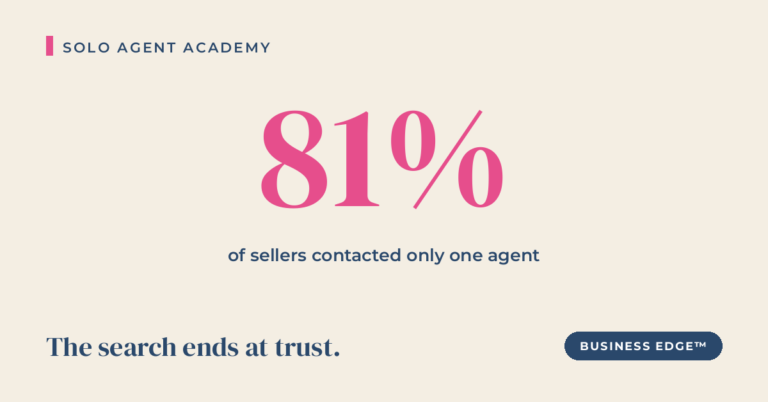
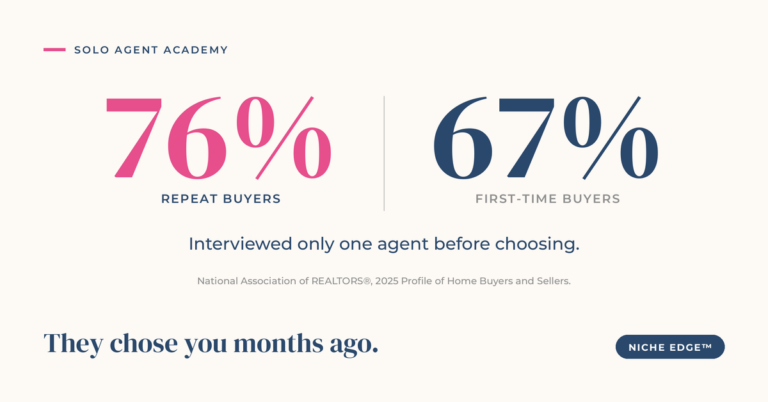
The real estate side explains why the trade matters so much for you. According to the National Association of REALTORS® 2025 Profile of Home Buyers and Sellers, 43% of recent buyers found their agent through a referral from a friend, neighbor or relative, and another 18% used an agent they had worked with before. Most buyers interviewed only one agent.
Most buyers choose an agent through someone they already know — and stop looking at one.
How buyers found their agent
Share of recent U.S. buyers
Interviewed only one agent
Share of recent U.S. buyers, by buyer type
The choosing happens inside relationships, usually before a buyer fills out a single form. Your email’s job is to keep you inside those relationships.
Source: National Association of REALTORS®, 2025 Profile of Home Buyers and Sellers. Recent U.S. home buyers who completed a purchase between July 2024 and June 2025.
That’s the job of your email. It isn’t there to capture strangers. It’s there to keep you in the relationship long enough to be the name someone says out loud when a friend asks, “Who should I call?”
The statistic we won’t use
You’ve probably heard it in a training room: the average person knows ten real estate agents. Or twelve. Or fifteen. The number changes with the speaker, and that’s the tell. We went looking for the study behind it and couldn’t find a credible national source for any version. So Solo Agent Academy doesn’t use one.
We don’t need it. The documented version of the point is stronger. Your consumer already has access to more than one agent, and the one they hire usually arrives through someone they know or someone they’ve used before. You don’t need to be one more agent in their inbox. You need a reason to be the one they’re glad to hear from.
An email address is an exchange, not a collection.
Build a Data Bank, not a list
At Solo Agent Academy, we call your database your Data Bank. I didn’t invent the term, but it’s the best one I’ve heard. Your CRM is the software. Your Data Bank is the business you build inside it: the people you know, the people who know you, the clients you’re helping now, the clients you’ve helped before, and the people who raised their hand and asked to keep hearing from you.
Not everyone belongs in it as a subscriber. A Facebook friend isn’t a subscriber. An Instagram follower isn’t a subscriber. Someone who downloaded one guide didn’t sign up for every newsletter you’ll ever send. And a purchased list of 10,000 addresses isn’t a Data Bank at all. It’s 10,000 people who never asked.
So the question changes. Not how do I get more email addresses? but what could I send that the right person would actually want?
This is where a niche earns its keep. Being the local authority for one type of residential property gives you something specific to send and a specific person to send it to. That’s the work of the Known Path™: becoming known for one thing by the people who already care about it. If you haven’t chosen yours yet, the Residential Property Niche Library is a good place to start.
The offer that got me real email addresses
“I actually made a short video with a mortgage lender about exactly that. Want me to send it to you?”
That was my line at open houses in Alaska, usually to first-time buyers close to the end of their search with a financing question they hadn’t been able to get answered. Nobody hesitated. They wrote their email down themselves.
The video existed because of where I’d come from. I spent more than seven years as the marketing liaison for mortgage and real estate lending at one of the largest credit unions in the country, and I stayed close with a few of the lenders — one in particular, a certified instructor who still teaches courses to agents. We started recording videos together, answering the questions buyers actually ask. (That series comes up again in Recognition Happens Before the Conversation.)
How often did that offer get me a fake email address? Never. People weren’t handing me their email. They were asking for the video, and the email was simply how it reached them.
The email wasn’t what they wanted. The information was.
What this sounds like at your next open house
Say you’ve chosen urban lofts on the northeast side of your city. You list one. Thirty people come through on Sunday.
The old move is the clipboard. The better move is one sentence:
“Thanks for coming by. Every week I track the urban loft market here on the northeast side — new listings, price changes, what’s gone under contract and what’s actually selling. Want me to add you to that update?”
Everyone standing in that loft already showed you what they care about. You just offered them more of it. That’s the whole difference. Not give me your email so I can market to you, but I know something you’re interested in — want me to keep you posted?
Your inventory is full of reasons like this. A listing prompts questions. A price change prompts interest. A neighborhood prompts curiosity. Each one turns into something a specific person will say yes to: a property alert, a weekly niche update, a “here’s what else is out there like this” note, a financing video.
Then track one number from that Sunday. Thirty people came through. How many asked you to keep in touch? That’s a figure you can improve, and it’s yours.
Do it right, every email, every time
Building your own list doesn’t make email a free-for-all. In the United States, commercial email falls under the federal CAN-SPAM Act, and the Federal Trade Commission’s compliance guide is plain about the basics. Your sender information has to be accurate and your subject line can’t mislead. Every marketing email needs your valid physical postal address and a clear, easy-to-find way to opt out.
That opt-out has to keep working for at least 30 days after you send, and you have 10 business days to honor a request. You can’t charge a fee, ask for anything beyond an email address, or require more than a reply or a visit to a single web page to leave. And hiring an email platform or a marketing company doesn’t hand off the responsibility. It stays with you.
Solo Agent Academy’s rule is simpler than the law: every ongoing marketing email carries an obvious way to unsubscribe. Don’t bury it. Don’t guilt anyone for using it. Don’t make them ask twice.
They gave you access to their inbox. They keep the right to take it back. That’s not only compliance. It’s trust. Your state and your brokerage can add rules of their own, so check with your broker before your first send.
Know your numbers before you chase a big list
This is where list-building advice gets expensive. Someone online has 50,000 subscribers. Someone else is selling a system to get you 10,000. Before any of that, answer the operating question: how many transactions are you trying to close?
Solo Agent Academy uses 60 meaningful real estate conversations per transaction as a planning benchmark. It’s our planning number, not an industry statistic, and it’s counted in conversations. Not names. Not followers. Not email addresses.
Twenty-four closings is a conversation goal, not a list size.
Your planning math
At 60 meaningful conversations per transaction
Swap in your own goal. Multiply by 60, then divide by 12 and by 52. Your email list is one of the places those conversations start.
Solo Agent Academy planning benchmark: 60 meaningful real estate conversations per transaction. A planning figure, not survey data. Weekly figure rounded from 27.7.
Now you know what your email is for. It’s one of the ways those 28 weekly conversations begin and keep going.
The urban loft subscriber opens your update three weeks in a row. On the fourth, she hits reply: “I saw the one on 8th Street went under contract. What did it sell for?” That’s a conversation. That’s your Data Bank doing its job.
Stop asking how to grow your list
Ask better questions. Why do I want this person’s email address? What will I send, and why would they want it? Did I deliver what I promised? Is there a reason to open the next one? Am I creating enough conversations to reach my goal?
Answer those, and the list grows the right way — one person at a time, each one with a reason to be there.
Sources: Federal Trade Commission, “CAN-SPAM Act: A Compliance Guide for Business” (current guidance). Merkle, Customer Engagement Report Q1 2022, survey of 2,000 U.S. adults 18+, conducted late 2021. National Association of REALTORS®, 2025 Profile of Home Buyers and Sellers, recent U.S. home buyers, July 2024–June 2025. Sixty conversations per transaction is a Solo Agent Academy planning benchmark, not survey data.
One next step
See what an email worth subscribing to looks like.
The Local Authority Brief™ is our free weekly email — the same exchange this article describes: one useful, local idea each week for the agents who asked for it.
Read The Local Authority Brief →