Why Your CRM Isn’t Producing Results
Your CRM isn’t broken. It’s doing exactly what it was built to do — you just hired it for the wrong job.
You bought the CRM. You imported the contacts. You built the drip campaigns and watched the training videos. Maybe you paid for coaching to learn it.
Months later: a database with hundreds of names and not much to show for it. No new listings traced back to it. No surge in referrals. So you ask the obvious question — why isn’t my CRM producing results?
Here’s the part no one tells you. It’s working exactly as designed. The problem isn’t the software. It’s the job you handed it.
Before you buy another system or import another list, answer one question: what was your CRM actually hired to do?
What a CRM Was Built For
Agents get sold CRMs through a lead-generation lens: load your contacts, turn on automation, stay top of mind, generate more business. The implied promise is that the software creates business.
It doesn’t — and no other industry expects it to. Financial advisors, insurance agents, lenders, recruiters all run CRMs. None of them expect the CRM to create trust or generate referrals. It organizes and supports those things. It doesn’t create them.
Strip away the branding and every CRM does the same five things:
- Store contact information in one place
- Record the history of your interactions
- Schedule tasks and follow-up reminders
- Track where each relationship stands
- Automate routine communication
Now notice what’s missing. It doesn’t create trust. It doesn’t build authority. It doesn’t win listing appointments or make people remember you. Those are your job. The CRM just remembers the details while you do it.
Which is also why the question of which CRM is best matters far less than agents think. They all do the same five things.
What Your Relationships Are Actually Worth
If the CRM’s real job is protecting relationships, here’s what those relationships are worth, straight from the NAR 2025 Member Profile:
| Finding | Share |
|---|---|
| Business from repeat clients (typical member) | 20% |
| Business from past-client referrals (typical member) | 21% |
| Combined: business from people you already know | 41% |
| Veterans (16+ years) whose repeat clients are more than half their business | 40% |
Source: National Association of REALTORS®, 2025 Member Profile.
41%. Nearly half of a typical agent’s business comes from people who already know them — and it climbs with every year you stay. 40% of agents with 16+ years get the majority of their business from repeat clients alone. That’s not a lead source. That’s a relationship base, and it only pays if it’s maintained. Maintaining it is the one job a CRM was actually built for.
Your Quiet Team™ Was Hired for the Wrong Role
Your CRM is part of your Quiet Team™ — the tools that hold a defined job inside your business. AI, the MLS, your file system, your CRM. Every member has an assignment, and the CRM’s assignment is the one most agents never actually give it.
You wouldn’t bring on an assistant and expect them to become the face of your business, win trust with strangers, or be the local expert. Yet that’s exactly what agents expect from a CRM.
The CRM was hired to remember. You were hired to build the relationships.
Confuse those two jobs and disappointment is guaranteed. The software does its job perfectly while you wait for it to do yours. That single mismatch is the biggest reason agents feel let down by software that, by every technical measure, works fine.
The Opportunity Most Agents Miss
Most agents use their CRM for a tiny slice of its job: internet leads, drip campaigns, reminders, basic storage. That’s the lead-management corner of a relationship-management tool.
Look at every relationship a real estate business actually runs on: past clients, active buyers and sellers, referral partners, lenders, attorneys, contractors, stagers, investors, community leaders, open-house visitors. Every one creates opportunity. Every one needs follow-up. Every one belongs in the CRM.
Use it only for internet leads and you’ve bought a full toolbox to use one screwdriver.
When relationships have no system maintaining them, they leak. Past clients drift. Referral partners forget you. Community contacts go cold — not because they didn’t matter, but because no one was managing them. With 41% of your business riding on those relationships, that drift is the most expensive thing in your pipeline.
A Lesson I Learned the Hard Way
I moved to Alabama with a CRM full of Alaska contacts. Not one of them could send me a deal in a market 3,000 miles away.
So I went looking for systems to rebuild — and learned the order the hard way. Visibility and relationships come first. The CRM can’t create either one.
But the moment a relationship existed, the CRM earned its keep. It remembered the conversation. It organized the opportunity. It tracked the follow-up I’d otherwise have lost.
It didn’t build the relationship. It protected it. That’s the whole distinction — and it changed how I’ve used a CRM ever since.
What Your CRM Should Actually Manage
Stop asking your CRM to generate business. Ask it to manage business across four areas:
Listings. Seller consultations, appointments, weekly seller updates, price-review reminders, open-house follow-up, post-closing retention.
Buyers. Consultations, property preferences, showings, offer tracking, contract milestones, post-closing follow-up.
Referrals. Referral sources, vendor relationships, agent-to-agent referrals, community partners, centers of influence.
Business partners. Photographers, contractors, stagers, accountants, transaction coordinators, local businesses.
Run all four and the CRM becomes the memory of your business — not just the inbox for your leads.
Three Changes You Can Make This Week
You don’t need a new CRM. You need to use the one you have differently.
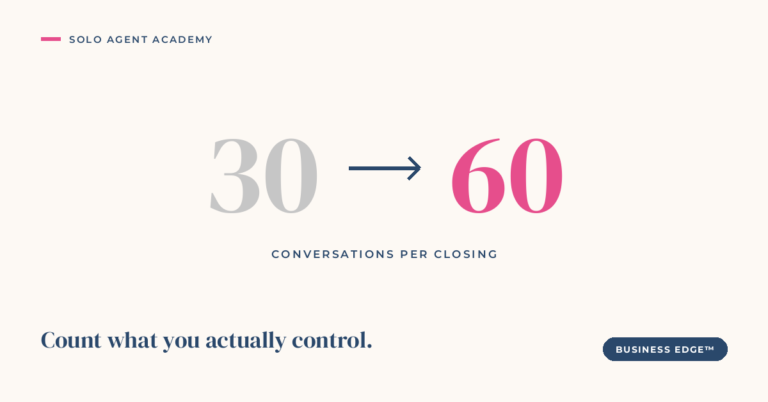
1. Stop counting contacts. Count conversations.
Contacts don’t close. Conversations do. Measure the thing that actually produces business.
2. Add every relationship, not just prospects.
Referral partners, vendors, community contacts, business partners. All of them belong in the system.
3. Use it as a memory system.
Log conversations. Record the details. Set the follow-up. Let the CRM remember what your brain shouldn’t have to.
The Bottom Line
Your CRM isn’t failing. It’s doing its job. You’ve been asking it to do yours.
It can’t create trust, authority, visibility, or relationships. But it can manage every one of them once they exist — and those relationships are worth 41% of your business, and more every year you stay.
The agents getting the most out of their CRM aren’t running it as a lead machine. They’re running it as the memory of their Quiet Team™ — the part of the business that never forgets a person, a conversation, or a follow-up. Stop asking it to sell. Start letting it remember.
One Next Step
Every relationship in your CRM needs a label before it can be managed. The Solo Agent Tagging System is the free interactive tool that gives you one — a clean structure for past clients, partners, and community contacts, built in about fifteen minutes.
Open the Tagging System