How to Become Known for Something as a Real Estate Agent
Visibility and recognition are not the same thing. One takes effort. The other takes the patience to repeat yourself past the point of boredom.
Sit through the marketing sessions at almost any real estate conference and you’ll notice what agents ask about. Reach. Followers. Engagement. Which platform is working right now. How often to post.
What almost nobody asks about is recognition.
That’s the one that pays, though, and the difference between the two is worth being precise about. Visibility means people have seen you. Recognition means they can tell you apart.
Think about what actually happens when a homeowner on your street decides to sell. They don’t open a spreadsheet and compare every agent in the county. They think of a name. Maybe two. Then they call the first one.
The agent who gets that call is usually the one who came to mind, not the one with the best marketing. And after enough years in this business I’ve come to think most independent agents are working extremely hard at being seen while doing almost nothing about being remembered.
The visibility trap
You have more marketing channels available to you than any agent in the history of this business. Facebook, Instagram, LinkedIn, YouTube, TikTok, email, your CRM, your website, Google Business Profile. The constraint isn’t opportunity.
The constraint is that most agents use all of it to talk about everything.
Monday is a first-time buyer tip. Tuesday is a luxury listing. Wednesday is a quote over a sunset. Thursday is an open house. Friday is a rate update. All of it competent, all of it useful to somebody, none of it connected to anything.
The result is an agent people have seen and can’t describe. The name is familiar. What the name is for is blank.
That matters because a consumer facing the largest financial decision of their life isn’t shopping for an agent. They’re shopping for confidence — someone who looks like they’ve handled this exact situation before. A general message can’t supply that, no matter how often it runs.
Where everyone is standing
There’s data on this, and it’s more specific than the usual claim that agents are all on social media.
NAR’s 2026 Member Profile asked members which platforms they use professionally. The answers show exactly where the crowd is standing — and where it isn’t.
Platforms REALTORS® use professionally
Source: National Association of REALTORS®, 2026 Member Profile, published June 2026. Figures describe professional platform use among members, not results produced.
Three out of four agents are on Facebook. Fewer than one in three are on YouTube. That gap is the most useful thing on the chart, and I’ll come back to it.
Now set that next to how sellers actually behave. NAR’s 2025 Profile of Home Buyers and Sellers found that 66% of sellers either used an agent they’d worked with before or found their agent through a referral. Thirty-five percent named the agent’s reputation as the deciding factor.
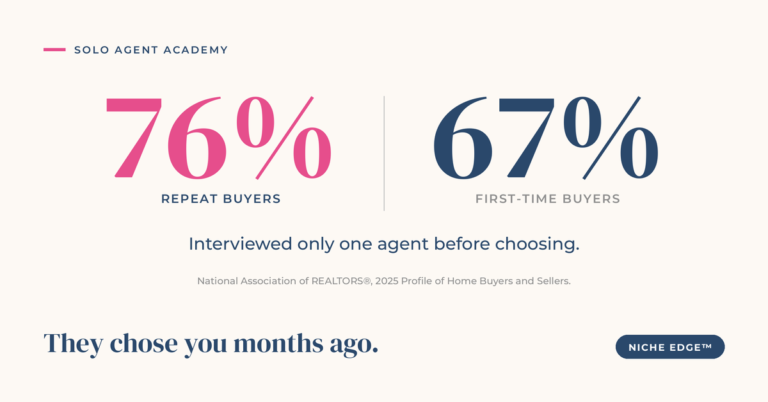
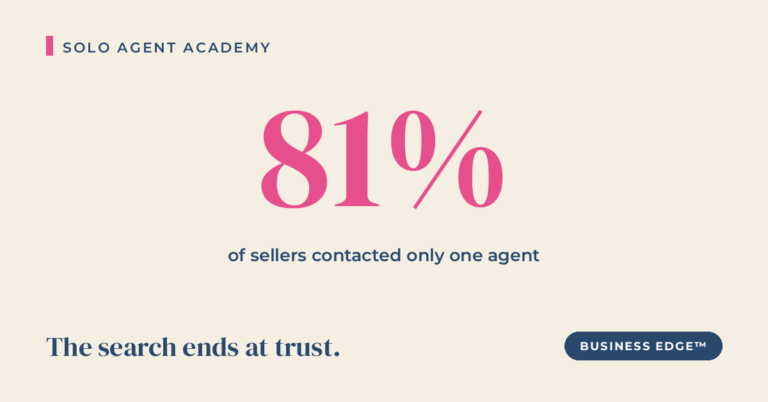
And the number that should reframe your whole marketing calendar: 81% of sellers contacted only one agent.
You were never competing at the listing appointment. That was the victory lap.
Four out of five sellers decided who to call before anyone got a chance to present. Whatever happens at the kitchen table, the real competition happened months earlier, quietly, in the form of a name that came to mind and names that didn’t.
What consumers actually say
Ask an agent where their business comes from and you’ll usually hear a channel. Social media. Zillow. The website.
Ask a seller how they picked their agent and you get something else entirely.
I kept seeing their signs. My neighbor used them. They sold the house behind us. I get their market updates. Somebody at work mentioned them. I’ve heard the name before.
Not one of those is about volume. Every one of them is about accumulation — the same name showing up in the same context enough times that it stopped being new information.
Recognition has an order to it
Inside Niche Edge™ we teach this as the Known Path™, because it isn’t a set of tactics. It’s a sequence, and the stages happen in order.
| Stage | What it means | What it takes |
|---|---|---|
| Clarity | You know what you want to be known for, specifically enough to say it in one sentence | A decision, made once |
| Visibility | The market has seen you saying it | Showing up where your niche is |
| Recognition | People connect your name to that thing without being prompted | Repetition, past the point it interests you |
| Trust | They believe you’re genuinely good at it | Being useful in public, consistently |
| Chosen | You get the call | Everything above, already done |
Most agents reach Visibility and stall there indefinitely. Not from lack of effort — from changing the message.
Here’s the part worth understanding. When you switch what you talk about, you don’t slide back a stage. You start a new path, at Clarity, from zero. The visibility you accumulated on waterfront homes doesn’t transfer to your new interest in investors. It stays with waterfront homes, attached to nobody in particular.
Run that cycle four times a year and you can work hard for a decade and never once arrive at Recognition. That’s the agent who’s been in the business twelve years and still introduces herself as a Realtor.
Become known for one thing, in one place
Agents who become local authorities generally don’t market more than you. They market narrower.
One residential property niche. One local market. Long enough that the market starts repeating your message back to you.
Niche Edge™ works from twenty-six residential property niches. A few of them:
- Historic Homes
- Waterfront Homes
- Golf Course Homes
- Condos
- Farms / Ranchettes
- 55+ Age-Restricted Homes
- Fixer Uppers
- Tiny Homes
- Barndominiums
- Urban Lofts
- Properties with ADUs
- Short-Term Rental Properties
Note what the list is not. It isn’t first-time buyers or move-up sellers or investors — those are client types, and client types rotate as the market shifts. A property niche sits still. The historic district is in the same place in ten years, and so is everyone who owns a house in it.
An honest limit. A niche has to be big enough to support you. Before you commit, count how many homes in your market actually fall into that category and how many changed hands last year. If the answer is eleven, that’s a specialty you add to a broader business — not a business. Narrowing is a positioning decision, and it still has to pass arithmetic.
Three activities, and that’s the whole system
The reason this is achievable as one person is that it doesn’t require daily content, paid advertising, or becoming an entertainer. It requires three things done on a schedule.
One: a weekly market update, on your niche only
Every week, publish a short read on what happened in your niche. New listings, pendings, closings, price reductions, inventory, days on market. Not the whole market — your slice of it.
If your niche is waterfront, you talk about waterfront. If it’s the historic district, you talk about the historic district. The discipline is in the restraint, and the restraint is what produces Visibility that accumulates instead of scattering.
Two: a monthly recap on video
Once a month, record a walkthrough of what happened in that niche market. What sold, what sat, where inventory is heading, what buyers are doing, what that means for an owner thinking about listing.
It doesn’t need editing, graphics, or a ring light. It needs to be useful and it needs to exist.
Go back to that chart. Seventy-six percent of agents are on Facebook competing for the same attention. Thirty-one percent are on YouTube. Now narrow that further — of the agents on YouTube, how many are publishing a monthly market report on one property niche in your market? In most markets the honest answer is zero.
That’s not a clever tactic. It’s just an uncrowded room, and this is the stage where Recognition actually gets built.
Three: make one piece of research do eight jobs
This is where most agents leave the value on the table. You did the research once. It should show up everywhere.
Online, the same market read becomes social posts, an email to your database, an article on your site, and a Google Business Profile post. Offline, it becomes a postcard, an open house handout, a talking point over coffee, and a community presentation.
The goal isn’t more work. It’s the same work, seen more times, saying the same thing. Repetition is what converts Visibility into Recognition, and one honest hour of research can carry a month of it.
The question to ask instead
Most agents open the week asking what to post today. It’s an activity question and it produces activity.
The better question is: what could I say every week for a year that would make someone think of me first six months from now?
One of those questions fills a calendar. The other one builds a business.
What this looked like for me
Melissa — your story goes here. This is the last piece before it publishes. The strongest version is probably the one where you watched somebody else own a niche you could have owned, or the stretch where you finally held one message long enough for it to stick and felt how long that took. Tucson, Anchorage, or Alabama all work. What readers most need is the honest timeline — how many months of feeling repetitive before anything came back. Send it in any shape and I’ll write it in.
Start here this week
- Finish this sentence in eight words or fewer. “I’m the agent people call about ___ in ___.” If you can’t fill both blanks, you’re at Clarity, and no amount of posting moves you off it. Pick the niche you already know most about, not the one with the highest price point.
- Do the arithmetic before you commit. Count the homes in that niche in your market and how many sold last year. You’re checking that the niche can carry a business, not just a brand.
- Put the weekly update on your calendar as a recurring appointment. Same day, same time, forty-five minutes. Treat it like a listing appointment, because it’s competing for the same outcome and it’s cheaper.
- Set a six-month review date and don’t evaluate before it. Write the date down. Recognition accumulates below the surface for months before anything visible happens, and most agents quit at month three — right before it starts working.
What you’re actually building
The goal was never followers, or views, or a better week on the algorithm.
The goal is that six months from now, when someone in your market mentions your niche out loud, your name is what comes to mind — and you weren’t in the room when it happened.
That’s local authority, and you don’t get it by announcing you’re the expert. You get it because the market decided, on the strength of watching you be useful about the same thing for longer than felt reasonable.
Being known for something is narrower than being known. It’s also the only version one person can build.
Not sure which niche is yours?
Picking the niche is the decision everything else waits on, and it deserves twenty minutes of honest thinking rather than a guess you’ll reverse in March. The Niche Quiz is built to help you make that one call — from the twenty-six residential property niches, against the market you actually work.
Take the Niche Quiz →Built for independent agents choosing one niche to own.