
The Framework
The Decision Bridge™
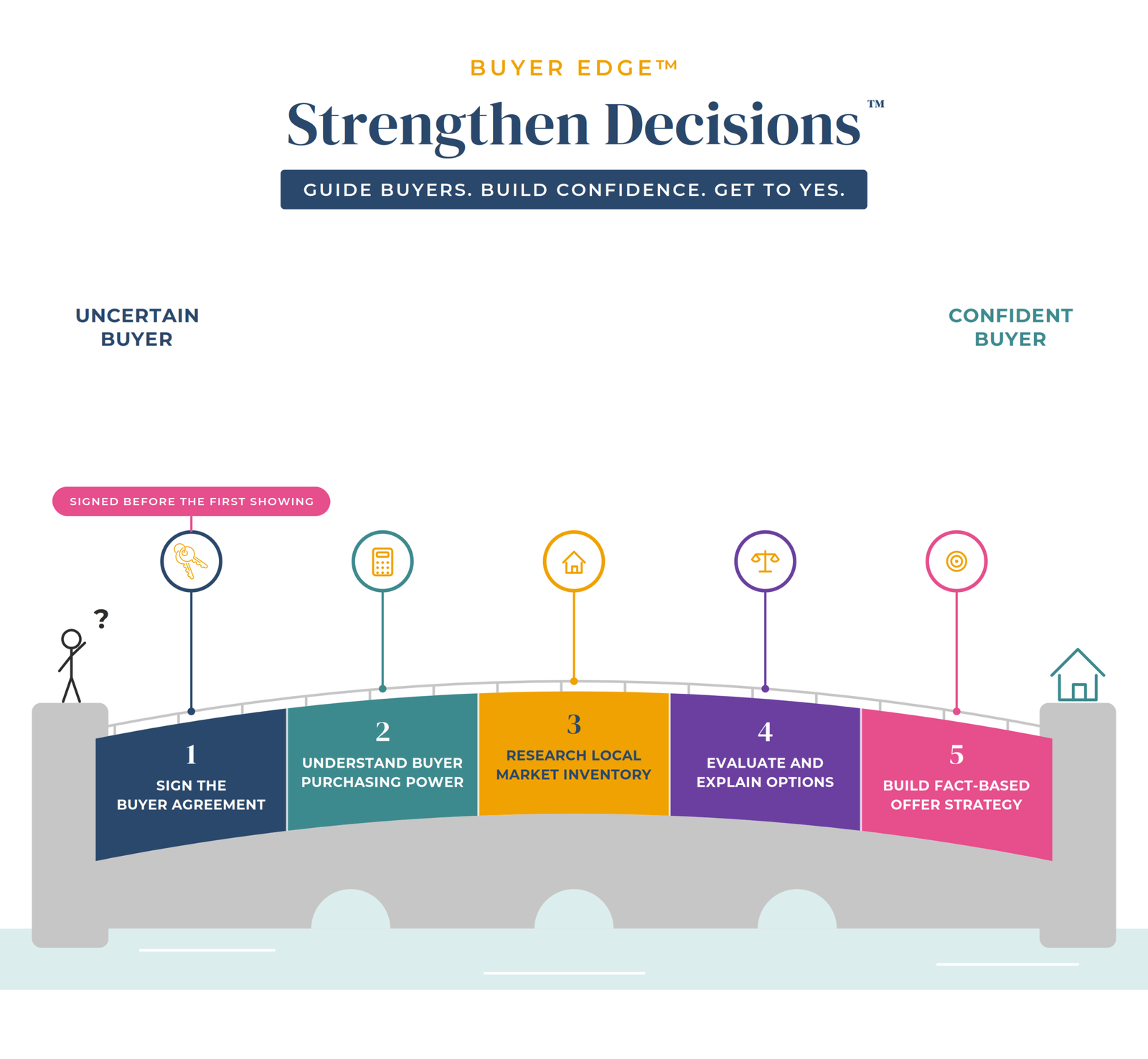
On one side stands your buyer — wanting, hoping, hesitating. On the other side is the decision they came to you to make. The bridge is what you build between them.
Five planks, laid in order: understanding, education, the numbers, strategy, commitment. Each one replaces a piece of uncertainty with something solid enough to stand on.
Build it before the right house appears and crossing feels natural. Skip the planks and the crossing has to happen under time pressure, which is when buyers freeze — or write an offer they regret.
One plank of clarity at a time.
Hesitation isn’t a no
A buyer who goes quiet after three showings hasn’t lost interest. A buyer who keeps asking about rates isn’t stalling for fun. They’re standing at the edge of the largest financial decision of their life, and the ground between wanting and acting looks like a canyon.
Most buyer-side training answers hesitation with urgency: act now, rates won’t wait, you’ll miss out. But pressure doesn’t shrink a canyon. It just makes people back away from the edge.
And the buyer knows the pressure is for your benefit, not theirs — which costs you the one thing that would actually have helped, which was their trust.
Hesitation is processing, not objection. Buyers who hesitate don’t need a push. They need a path.
The work isn’t finding confident buyers. Confident buyers aren’t found — they’re built, in the weeks before anything urgent is happening.
You can’t push someone across uncertainty.
Naming what’s actually happening changes what you do next — and on the buyer side, what you do next is usually the difference between a client and a ghost.
“They went quiet on me.”
→
“A plank is missing. Which one?”
“They’re not really ready.”
→
“They’re not prepared yet. That part is mine.”
“They keep asking about rates.”
→
“They’re asking about the payment. Answer that.”
“We’ll figure out the offer when we find one.”
→
“We’ll decide the offer while nobody’s rushing.”
“They need to see more houses.”
→
“They need to know what they’re looking for.”
The five planks
Laid in order, before they’re needed.
Each plank replaces a specific piece of uncertainty. Skip one and the bridge holds until the moment weight goes on it — which is always the worst possible moment to find out.
1
Understanding
“Tell me what you’re actually hoping for.”
A real consultation that surfaces what they want and what they fear. Not a qualification call — a conversation where you learn the things that will decide this purchase, most of which they haven’t said out loud yet.
What people fear on the buyer side is rarely the house. It’s the payment in a bad month, the commute they’ll resent, the decision they can’t undo. None of that comes out in response to “what’s your price range.”
How you lay it
A structured first meeting with real questions, before any showing. What they want, what they’re protecting, what would make this a mistake in their own words.
Missing this plank: you show houses against a list of features and never learn why none of them land.
2
Education
“Nobody explained any of this to us.”
The process in plain language, before the pressure starts. Inspections, appraisals, contingencies, timelines, what’s negotiable and what isn’t — explained while it’s abstract rather than while it’s happening.
Surprises get a vote in a decision. A buyer who learns about the appraisal gap for the first time during the appraisal makes that decision frightened, and frightened buyers back out of good deals.
How you lay it
Walk the whole timeline early, with the hard parts named. What could go wrong, what you’d do about it, and what it would mean for them.
Missing this plank: every normal event in a transaction arrives as a crisis, and you spend the escrow reassuring instead of advising.
3
The Numbers
“What is this actually going to cost us every month?”
Payment math and scenarios that turn vague worry into known figures. This is the plank buyers are silently standing on when they ask about rates — the rate isn’t the question, the monthly number is.
It’s also where most hesitation actually lives. A buyer who can see the payment, the cash to close, and what a buydown or concession would change has something concrete to decide about instead of a fog to worry inside.
How you lay it
Real figures, side by side. What this house costs monthly, what waiting costs, what a different price or structure would do. Numbers they can take home.
Missing this plank: they keep asking about rates and you keep answering about rates, and neither of you gets to the actual question.
4
Strategy
“If we find it, here’s exactly what we’ll do.”
An offer approach agreed on in advance — price ceiling, terms, contingencies, what you’d compete on and what you wouldn’t. Decided calmly, on a Tuesday, with nothing on the line.
The right house always creates time pressure. A buyer who has to invent a strategy inside that pressure either freezes and loses it, or overreaches and spends the next year uneasy about what they agreed to.
How you lay it
The offer conversation before the house exists. Written down, agreed to, and ready to execute the day something right shows up.
Missing this plank: the strongest move gets made in the least calm hour of the process, by someone who’s never done this before.
5
Commitment
“We’re ready. Let’s write it.”
A buyer who steps forward because they’re ready, not because they were rushed. The last plank isn’t something you build — it’s what the first four make possible.
Commitment that arrives this way behaves differently all the way to closing: fewer renegotiations, fewer cold feet at the inspection, fewer regrets afterward. And the buyer who felt guided rather than pushed is the one who sends you their sister, their coworker, and their best friend.
How you lay it
Confirm rather than close. Does this match what you told me you wanted? Are we aligned on the number? Then write it.
Missing this plank: you get a signature and an anxious client, and you find out which it was during the inspection period.
Where the bridge is broken
When a buyer stalls, the useful question isn’t whether they’re serious. It’s which plank isn’t there. Each one fails in a way you can recognize from what they’re saying:
What they keep asking about → the plank that’s missing
| What you’re hearing | The plank to build next |
|---|---|
| “We’re not sure what we want” | Understanding — the consultation didn’t go deep enough |
| “What happens if the inspection…” | Education — the process is still a black box |
| “What about rates?” | The Numbers — they mean the payment, not the rate |
| “We’d have to think about it” | Strategy — no decision was made in advance |
| Silence after three showings | Usually one of the first three, not the fifth |
A diagnostic, not a script. The point is to stop treating every stall as the same problem — because the answer to a missing numbers plank does nothing for a missing understanding plank.
Silence after three showings almost never means “not interested.” It means a plank you skipped is now load-bearing.
What keeps the bridge standing
Buyers take months. You have one memory.
A prepared buyer might still take ninety days to find the right house. Staying present and useful across those ninety days, for eight buyers at once, is not something willpower solves.
Your Quiet Team™ stays present
Saved searches, follow-up sequences, and market notes that keep going out while a buyer waits — so the quiet months don’t end the relationship.
Your planner tracks the buyers
The Edge Business Partner™ organizes buyer prospects where you can see them — who’s where, which plank is next, and what each one needs.
You build the planks
The consultation, the explanation, the math, the strategy conversation. Every plank is human work, and it’s the reason a buyer chooses you at all.
Start free
The Buyer Confidence Tool
Measure where a buyer stands and see exactly which plank of the bridge to build next. No signup, no email required.
Measure buyer confidenceAvailable now
The Decision Gap Market
The bridge explains what to build. This book explains why buyers hesitate in the first place — the six-stage Decision Gap Loop™ that runs between awareness and commitment, and what to say at each stage instead of pushing.
Buyers spend most of their time in stages three and four, hesitation and rationalization. The book is largely about those two.
Paperback · Also in Kindle and audiobook · Stands alone; no other book required
Free tools for building planks
Build it before they need it.
Somewhere in your database right now is a buyer standing at the edge, waiting for someone to make the path clear. They aren’t going to ask you for a bridge — they’re going to go quiet. Build it anyway, one plank at a time, before the right house makes it urgent.