
Tools › Buyer Edge™ › The Winning Offer Workbook
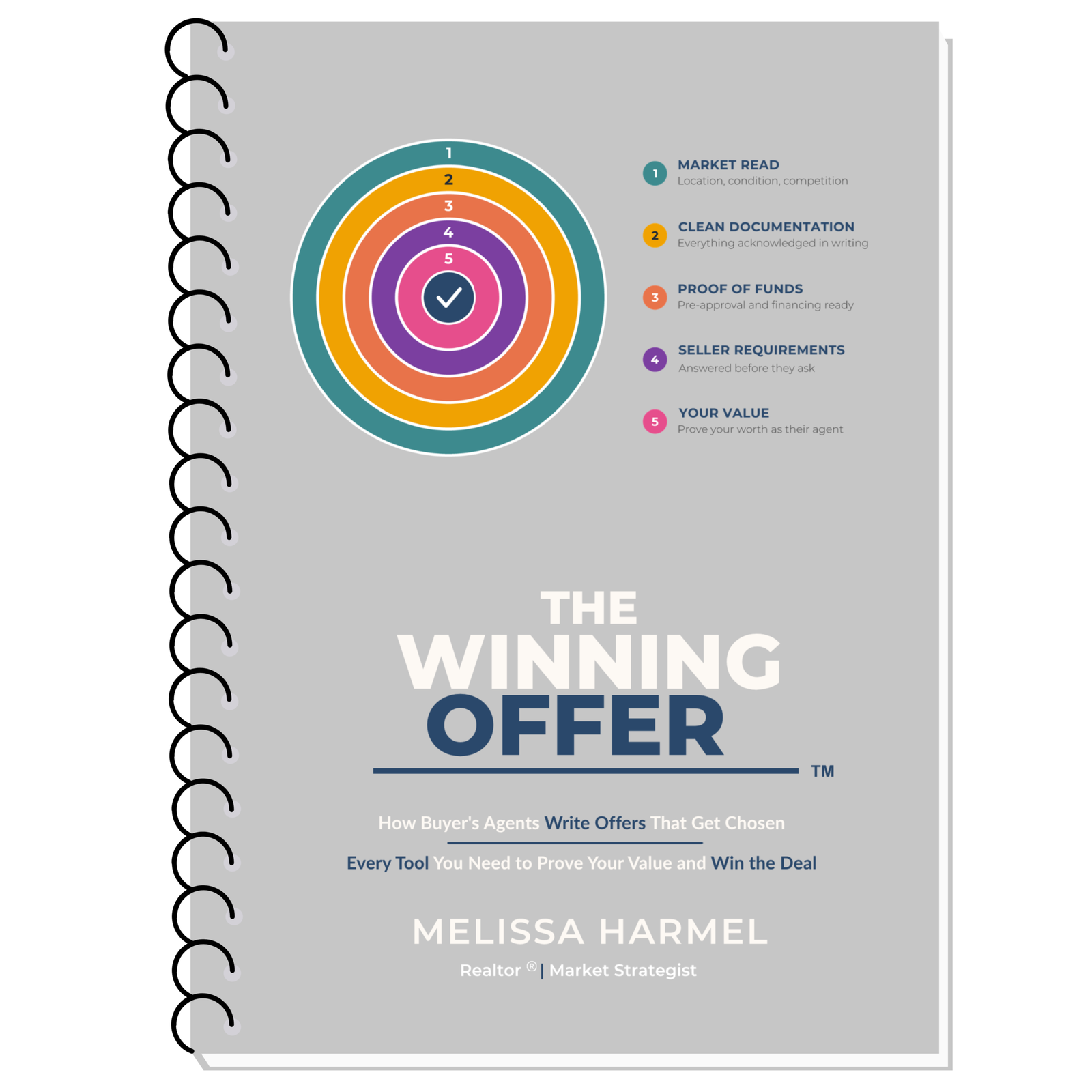
The Winning Offer Workbook
The strongest offer is the one that was decided on a Tuesday, before anybody was on the clock.
A working build of plank four of the Decision Bridge™ — the offer conversation you have before the right house exists. Price ceiling, terms, contingencies, and what you’d compete on, agreed in writing while everyone is calm.
- Format
- Spiral-bound, 8.5×11
- Price
- $39.97
- Framework
- Decision Bridge™
You’ll hear when it’s ready — and nothing else you didn’t ask for.
Why this workbook exists
The offer gets decided in the worst possible hour.
Here’s how it usually goes. Saturday afternoon, the buyer walks into the house they’ve been looking for since March, and something changes in the room. There are two other cars outside. Offers are due Monday.
And that — right there, in the least calm hour of the entire process — is when most buyers decide their price ceiling, their contingencies, their escalation, and what they’re willing to waive. People who have never done this before, deciding the largest financial terms of their life, with a clock running.
They either freeze and lose the house, or they reach past what they meant to and spend the next year uneasy about it. Both outcomes get blamed on the market.
The offer was never supposed to be decided on Saturday. It was supposed to be decided in March.
This workbook is that March conversation, structured — so when Saturday arrives, your buyer isn’t deciding anything. They’re executing something they already agreed to when they were thinking clearly.
The spine of the book
Six chapters. One offer strategy, decided in advance.
Each chapter is a conversation you have with a buyer before there’s a house, and it ends with something written down that you both agreed to.
1
The ceiling
Not the pre-approval number. The number they’re actually comfortable paying every month, in a bad month.
What you build
- The comfortable monthly payment, separate from the qualified one
- What that translates to in purchase price at today’s numbers
- The line they agree in advance not to cross
2
The terms that aren’t price
Closing date, possession, repairs, personal property — the levers buyers forget they have.
What you build
- Which terms your buyer can be flexible on, and which they can’t
- What flexibility is worth to a seller in your market
- The trade list: what you’d give to hold the price
3
Contingencies and risk
What each one protects, what waiving it actually exposes, and where your buyer’s real tolerance sits.
What you build
- A plain-language walkthrough of each contingency and its purpose
- Your buyer’s stated tolerance, decided calmly and written down
- The line on waiving — agreed before anyone suggests it
4
Competing without overreaching
What to do when there are three other offers, decided before there are three other offers.
What you build
- Your buyer’s multiple-offer plan, agreed in advance
- What you’ll compete on and what you’ll walk away from
- The permission to lose one — set while it’s hypothetical
5
Concessions and structure
Why a seller contribution sometimes does more for a payment than a price cut of the same size.
What you build
- A worked comparison of price reduction versus contribution
- The questions to ask a lender before the offer, not after
- The structures worth asking for in your market right now
6
The written strategy
One page your buyer signs off on, and you both work from when the house finally appears.
What you build
- The one-page strategy summary, agreed and dated
- Your pre-offer confirmation questions
- The review cadence, so it stays current across a long search
How it’s structured
Three parts. Built to be worked, not read.
Part One
Set the numbers
The comfortable payment, the real ceiling, and what both mean in purchase price. You finish with figures your buyer chose rather than figures a lender approved.
Part Two
Decide the terms
Contingencies, flexibility, competition, and structure — worked through while nothing is urgent, and written down in the buyer’s own words.
Part Three
Run it on the day
The one-page strategy, the pre-offer confirmation, and the review rhythm that keeps it current if the search runs six months.
Roughly 30% reading, 70% work. If you finish a chapter with nothing written down, the chapter failed.
This is for you if
- You’ve watched a buyer freeze on a house they wanted
- Your offer conversations happen after the showing, not before
- You want buyers deciding terms calmly rather than at a deadline
- You’d rather prepare a buyer than persuade one
- You’re staying independent and need systems, not a bigger payroll
This isn’t
- A negotiation-tactics book or a set of closing techniques
- Legal, lending, or tax advice of any kind
- A book you read once and shelve
- Dependent on any other Solo Agent Academy book — it stands alone
- Software. It’s paper, on purpose, because paper gets used.
Contract terms, contingency rules, and what may be waived vary by state, by contract form, and by loan program. This workbook structures the conversation and the decision — it doesn’t replace your broker’s guidance, your contract, or advice from a lender or attorney.
Don’t wait on the workbook
Have the conversation earlier this month.
These six tools are free and live now. They won’t build the full strategy or hold it across a long search — that’s what the workbook is for — but they’ll move the offer conversation earlier than Saturday afternoon.
Be the first to know.
The Winning Offer Workbook arrives in February 2027. Join the waitlist and you’ll hear when it’s ready — along with the free tools and articles that build the same preparation in the meantime.