Busy Is Not Booked
Two agents each take a hundred listing appointments this year.
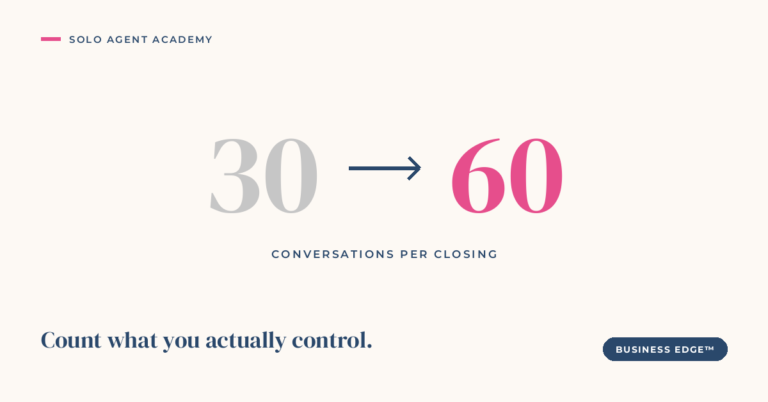
The first signs sixty agreements, gets fifty-five listings to market, and closes forty-one. The second signs seventy-five, gets seventy-one to market, and closes sixty. Identical calendars. Nineteen more closings.
The buyer side runs the same way. A hundred consultations each: one agent writes seventy buyer agreements and closes forty-three, the other writes eighty-five and closes sixty-one. Eighteen closings apart, on the same number of hours.
The belief underneath almost every slow quarter is that production is a volume problem. Business is down, so book more. The entire diagnostic vocabulary of this industry points at the top of the funnel — more appointments, more showings, more activity, more people. And it is not wrong. If you genuinely aren’t talking to anyone, more conversations will fix it, and nothing else will.
But volume is the first lever. Most agents never reach for the second one.
Here is what the second lever is worth. Say the first agent wants sixty closings. At their current rate they need roughly a hundred and fifty listing appointments to get there — fifty more appointments, which is fifty more evenings, fifty more drives, fifty more preparations. The second agent arrives at sixty closings on a hundred appointments. Same destination. One agent bought it with time they will never get back. The other built it into the process once.
The difference was never activity. It was what happened after the appointment.
The second agent got better at helping a seller understand price without feeling cornered. Better at setting expectations that survive week three. Better at moving a listing from live to closed instead of hoping the market does it. Better at helping a buyer become genuinely purchase-ready before the first showing. The appointment didn’t multiply. It got more valuable.
Every agent I know has answered a slow month by adding to the calendar. I have. It feels like control, and it is the most expensive form of control available.
Volume survives as the default answer because volume is visible. You can count appointments. You can point at a full week. You cannot see the twenty minutes inside a listing consultation where a seller quietly decided to trust you, and you cannot put that on a whiteboard. So agents optimize the number they can see and leave the number that actually moves income untouched for years.
Start by counting the four steps instead of the days. On the listing side: appointments, agreements, listings live, closings. On the buyer side: consultations, agreements, contracts, closings. Eight numbers, and most agents have never written down one of them. You cannot improve a rate you have never calculated.
Then find the widest leak. Look at where the number drops hardest — appointment to agreement, agreement to live, contract to close. That drop is your business telling you exactly where the next twenty closings are sitting, and it is almost never at the top.
Then work on one of those numbers for one quarter. Not four. One. A single rate moved five points does more for the year than a calendar you cannot sustain past March.
And change what a full week means to you. A full calendar is an input. It was never the result.
One Next Step
The Edge Business Partner™ Quarterly Planner tracks all eight of those numbers for you, quarter by quarter, so the leak shows itself instead of hiding. Choose the tier that matches your closing goal.
See the Quarterly Planners