The Framework
The Business Flywheel™
Five stages, in order, every time. Every closing you will ever have started as an action you took months before it appeared on your calendar.
Most agents track the last stage and wonder about the first four. The flywheel makes the whole chain visible — what you did, who you talked to, what it turned into — so a slow month stops being a mystery and starts being a number you can find.
It turns in one direction only. Push it and it builds speed. Stop pushing and it keeps turning for a while on what you already put in, which is exactly what makes a quiet quarter so easy to miss.
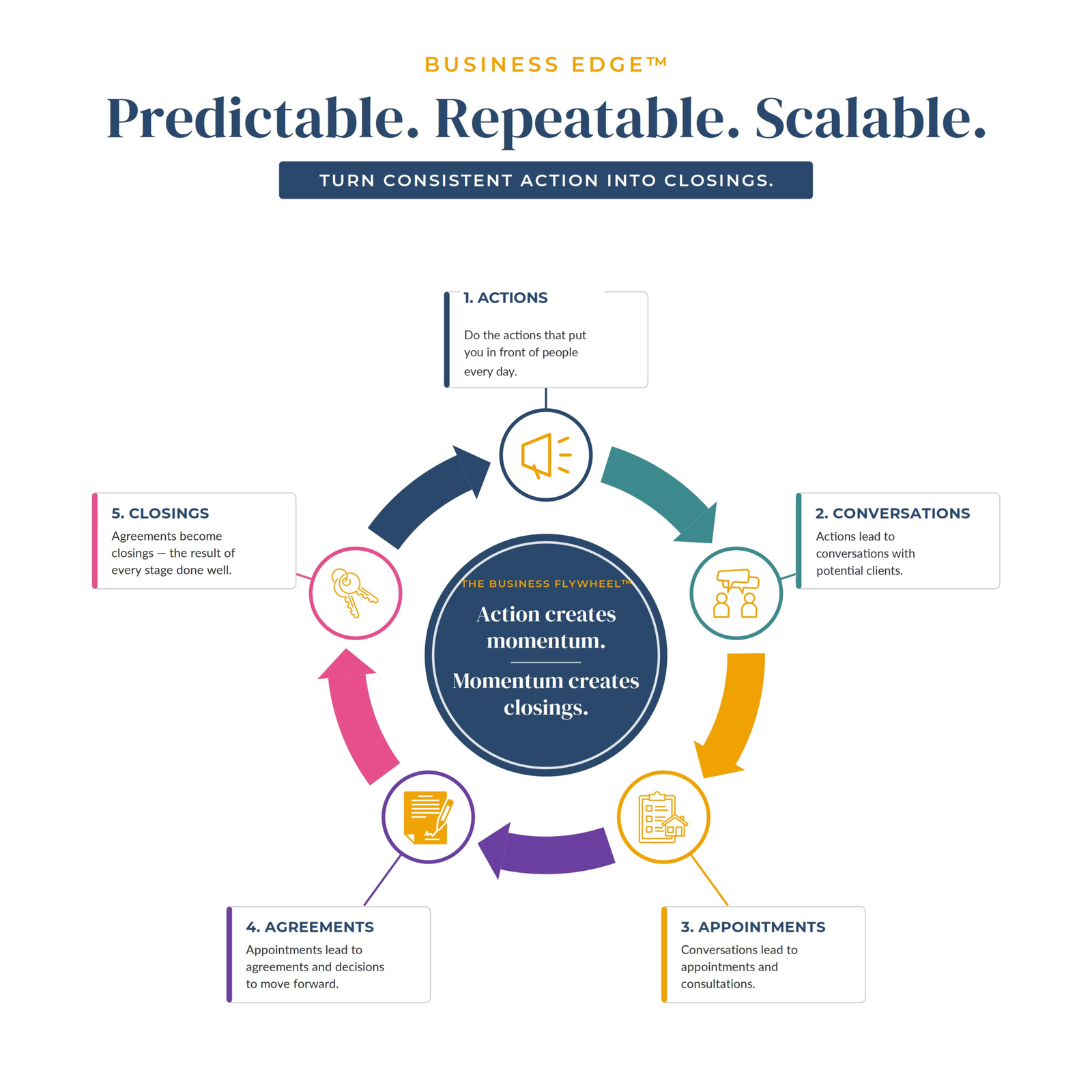
Actions turn first. Closings turn last.
Most agents count the wrong end
Ask an agent how the business is going and you’ll hear about closings — how many closed last month, what’s under contract, what fell out. It’s the number everyone tracks because it’s the number everyone gets paid on.
It’s also the only stage you can’t do anything about today. A closing in October was decided in June, by whether you had the conversations. By the time the number is bad, the work that would have fixed it is three months behind you.
This is why the year feels like weather. Good months and bad months arrive with no apparent cause, and the agent living through them has no way to tell whether November is coming in strong or empty — because nobody counted the first stage.
A slow month is not bad luck. It’s a quiet month, ninety days ago, finally showing up.
The fix isn’t working harder. It’s moving your attention one stage back — to the part of the wheel you can actually turn this week.
It isn’t a mystery. It’s a sequence.
Naming the stage changes the sentence you say to yourself — and the sentence you say to yourself determines what you do Monday.
“I need more leads.”
→
“I need more conversations.”
“It was a slow month.”
→
“It was a quiet month, ninety days ago.”
“I don’t know where my business comes from.”
→
“I never counted the first stage.”
“I’ll get organized when things slow down.”
→
“The slow part is what disorganization produced.”
“I worked hard all week.”
→
“I had four conversations all week.”
The five stages
Each one feeds the next.
They aren’t five names for the same activity. Each stage has its own number, its own failure, and its own tell when it’s the one that stopped.
1
Actions
The work nobody sees and everything depends on.
The daily work that puts you in front of people — the post, the note, the market update, the door you knocked on, the coffee you scheduled. Actions are the only stage that is entirely within your control on any given Tuesday.
They’re also the easiest to skip, because nothing bad happens when you do. Skip a day of actions and your week looks exactly the same. Skip a month and your October disappears.
What it counts
The 13 Edge Actions™ — the specific, repeatable activities that put you in front of people. Countable on purpose, so “I was busy” becomes a number.
When it stalls: nothing. That’s the danger — the wheel coasts for weeks on momentum you built earlier.
2
Conversations
Real exchanges with real people. Not scripts — conversations.
An action that never becomes a conversation didn’t move the wheel. This is where the business actually lives: a phone call, a message thread that goes somewhere, ten minutes at a soccer game where someone mentions their lease is up.
It’s the single most predictive number in a solo business. Agents who know their weekly conversation count know roughly what their quarter will look like. Agents who don’t are guessing about their own income.
What it counts
Every real two-way exchange about real estate with a real person — regardless of whether it felt productive at the time.
When it stalls: the calendar stays full and the pipeline quietly empties. Activity without conversation is the most expensive kind of busy.
3
Appointments
The conversation moved to a calendar.
Buyer consultations, listing appointments, sit-downs with real intent. An appointment is a conversation that earned time — the point where someone stops chatting and starts considering.
This is the stage where positioning shows up. Agents with a clear niche convert conversations to appointments at a rate general agents never match, because the person already knows what they’d be hiring you for.
What it counts
Scheduled, purposeful meetings — buyer consultations and listing appointments. Not showings, not coffee, not “let’s stay in touch.”
When it stalls: plenty of conversations, no calendar. Usually a signal that nobody is clear on what you specifically do.
4
Agreements
Commitment on paper.
Signed buyer and listing agreements. The moment a prospect becomes a client and your work becomes protected. This stage is where hesitation lives — where someone who wants to move stalls in front of the decision.
It’s the stage most agents are least honest with themselves about, because a conversation that went well and never got signed still feels like progress. It isn’t. The wheel doesn’t turn on enthusiasm.
What it counts
Executed buyer representation and listing agreements, dated. Signed or not signed — there’s no partial credit at this stage.
When it stalls: appointments that end warm and go nowhere. The gap between interest and commitment is where most solo income is lost.
5
Closings
The result the whole wheel exists to produce.
The stage everyone counts and nobody can control. By the time a closing happens, every decision that produced it was made months earlier — which is why it’s a scoreboard, not a steering wheel.
What a closing is genuinely good for is looking backward. Sort your last twenty by which action started them and you’ll learn more about your business than any amount of forecasting will tell you.
What it counts
Closed transactions and the GCI they produced — plus, if you’re tracking well, the action that started each one.
When it stalls: you find out ninety days late. Which is the entire argument for counting stage one.
The math runs backward.
The flywheel is useful because it’s arithmetic. Start with the closings you want, divide by the conversations it takes to produce one, and you get a weekly number — a target you can hit or miss by Friday instead of finding out in December.
Solo Agent Academy plans against an anchor of roughly 60 conversations per closing. Here’s what that looks like across three tiers:
| Closings | Conversations per year | Per week |
|---|---|---|
| 12 | 720 | About 14 |
| 24 | 1,440 | About 28 |
| 36 | 2,160 | About 42 |
The 60-conversation anchor is a Solo Agent Academy planning standard, not an industry statistic. Your own ratio will differ — and once you’ve tracked a quarter, use yours instead. That’s the point of counting.
Twenty-four closings isn’t a goal. Twenty-eight conversations a week is a goal. The closings are what happens if you keep it.
What keeps the wheel turning
You are not the whole machine.
The flywheel fails on capacity, not commitment. Nobody stops having conversations on purpose — it happens in a busy quarter, when three transactions are closing and the week disappears. That’s what systems are for.
Your Quiet Team™ remembers
CRM, MLS, AI tools, file systems. Follow-up, campaigns, reminders, records — the work that has to happen on schedule happens on schedule, whether or not you remember.
Your planner directs
The Edge Business Partner™ holds the strategy — the goal, the actions, the tracking, the review. It’s what points the Quiet Team™ at the right work.
You do what only you can
Judgment, conversations, and advocacy. The human work every other system exists to protect.
Start free
The 13 Edge Actions™ Momentum Tool
Enter your closing goal and get the weekly action number behind it — the flywheel, made countable. No signup, no email required.
Find your weekly numberAvailable now
The Edge Business Partner™ Planner
Knowing the number is the easy part. Holding it for ninety days is the work — and that’s what the planner is for. Every day gets a two-page spread with the 13 Edge Actions™ already printed on it, so tracking isn’t a system you have to build each morning.
Seven tiers, each calculated to a different annual closing goal. Set the quarter, work the actions, review like an owner. It’s the flywheel with somewhere to write it down.
Coil bound, 8.5×11 · Quarterly · Seven tiers, 12 to 100 closings · $77–$147
Free tools to work the wheel
Turn the first stage.
You can’t push a closing. You can have a conversation today, and another one tomorrow, and by the time the quarter is over the wheel is carrying weight you didn’t have to force. Start counting stage one and the rest stops being weather.