A Price Reduction is a Guess
Showings slow down. Two weeks pass with nothing. The seller calls and asks what we should do.
Most of us answer the same way. Let’s reduce the price.
Sometimes that’s right. But notice what just happened — a recommendation got made before anyone established what was actually stopping buyers. That’s a prescription written before the exam.
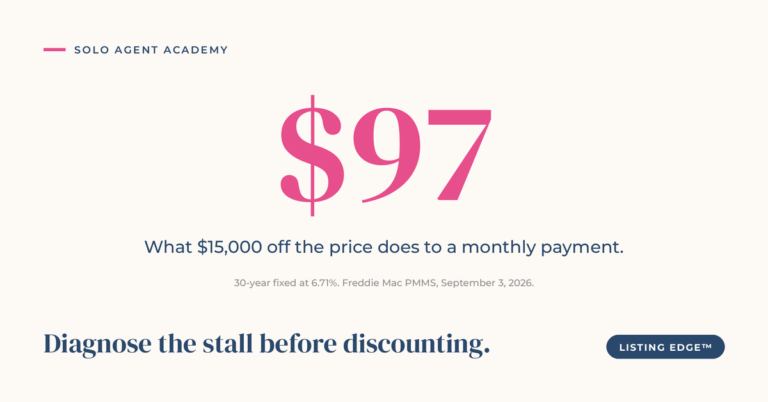
Run the number. Say the seller agrees to come down $15,000.
Rate: Freddie Mac Primary Mortgage Market Survey, September 3, 2026
Fifteen thousand dollars of the seller’s equity, and the payment moves by less than a hundred dollars. That may be exactly enough. It may also be a rounding error against whatever is actually in the way.
Here’s what reframes the conversation: the seller was already willing to give up $15,000. That was never the variable. The variable is what those dollars buy.
Same $15,000 as a closing cost credit, and a buyer who qualified but couldn’t assemble the cash can suddenly reach the table.
Same $15,000 toward a temporary rate buydown, and the payment in the early years moves considerably more than $97 — how much depends on loan size and structure.
Same $15,000 as a repair credit or a repair escrow, and the buyer who walked over the roof stops walking, while the contract price holds.
Some of that default is a hangover from the early 2020s, when homes sold in a weekend and a reduction meant something had gone wrong. Plenty of sellers still read a quiet third week as proof of a pricing mistake, and plenty of us still confirm it for them.
But price is only one of the things a buyer can be stuck on. Before recommending anything, find out which one it is.
Are buyers even seeing it? Showing counts, online traffic, saved searches. If nobody is coming through, a discount is being offered to an empty room. That’s a marketing problem and it needs a marketing answer.
Are they coming and leaving? Then you have feedback, and feedback is diagnosis. Condition, competition, layout, or price — the buyers who walked already told you, assuming someone wrote it down.
Are they qualifying but short at closing? Cash-to-close stops more purchases than payment does, and nothing fixes it as directly as a credit.
Is the payment itself the wall? Then the money belongs where payments live, not where the sale price lives.
All of this sits inside limits — how much a seller can contribute depends on the buyer’s loan program, which makes the lender part of this conversation rather than an afterthought.
None of it makes a price reduction wrong. Sometimes the home is simply above the market and everything else is noise. The point is being able to say which one it is before you recommend it, and being able to tell the seller why the other three don’t fit.
That’s a different meeting than most sellers are used to. It’s also the one that makes them believe you when the answer finally is price.
A free tool built on a single question: what would need to be true for this to work? Run it on the stalled listing before you run it on the price.
Open the Tool