How to Get More Listings Without Buying Leads
One listing returns five different things. Most agents collect one of them — and the seller next door quietly hires someone else.
If I were sitting across the table from you at a coffee shop and you asked me how to get more listings, I could probably guess where you’d start.
Zillow leads got expensive. The referral fees are eating the closing. The online leads that do come in aren’t ready to do anything yet. And underneath all of it is the quieter question: what’s the lead source I haven’t tried?
What might surprise you is that I probably wouldn’t start with lead sources at all.
I’d ask you something else first.
What are you doing with the listings you already have?
Not because buying leads is wrong. Plenty of agents build real businesses that way. But before you spend another dollar acquiring a seller, there is usually a larger opportunity sitting in your own MLS — already paid for, already yours to work.
What a purchased seller actually costs
Let me put numbers to it, because this cost is easy to feel and hard to see.
Referral networks are the most common way solo agents buy sellers, and they feel inexpensive because nothing leaves your pocket up front. No ad spend. No monthly minimum. The expense simply moves to the closing table.
Published fee ranges are consistent across the industry: agent-to-agent referrals commonly settle around 25% of gross commission, within a broader range of 20–35%. The consumer-facing networks — the ones that hand you a screened lead — sit at the higher end, generally 30–35%.
Now run that through a solo business.
Assume you close 24 transactions a year. Using the Solo Agent Academy planning model, roughly 60% come from listings and 40% from buyers — about 15 listings. Assume $10,000 in average gross commission per transaction. Those are assumptions, not claims. Substitute your own numbers; the shape doesn’t change.
What it costs to buy your listings
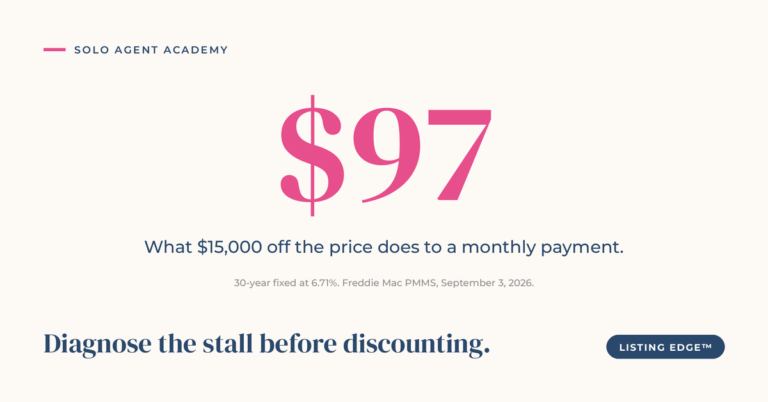
| Listings from a referral network | At 25% | At 30% | At 35% |
|---|---|---|---|
| 5 listings | $12,500 | $15,000 | $17,500 |
| 10 listings | $25,000 | $30,000 | $35,000 |
| 15 listings | $37,500 | $45,000 | $52,500 |
Referral fee paid on $10,000 average gross commission per transaction. Fee percentages reflect published industry ranges for agent-to-agent referrals (20–35%, commonly 25%) and consumer referral networks (typically 30–35%).
That $45,000 comes off the top — before brokerage split, taxes, MLS dues, insurance, marketing, and every other cost of running an independent business.
This isn’t an argument that referral networks don’t work. It’s an argument that they’re a purchase. And every purchase deserves one question: is there something I already have that does this job?
The sellers you want were never on a lead site
Here’s the finding that reframed this for me.
The National Association of REALTORS® 2025 Profile of Home Buyers and Sellers found that 66% of sellers either used an agent they had worked with before or found their agent through a referral.
Two out of three listings in this country are won on relationship and memory — before any competition begins.
How sellers chose their agent
Source: National Association of REALTORS®, 2025 Profile of Home Buyers and Sellers. The FSBO share of 5% is an all-time low.
The same study found that most sellers contacted only one agent before choosing who to work with. Read that next to the 66% and a picture forms: the seller decides who to call before they decide to sell. By the time a listing appointment is on the calendar, the decision has largely been made. There was no competition. There was a name that came to mind.
One more number from the same study, and it’s the one I’d underline.
The typical seller had lived in the home 11 years before selling — a record high.
Eleven years is a long time to be somebody’s neighbor. It is also a long runway. The people who will list on your street two years from now are already living there, already watching, and already forming an impression of who works this neighborhood.
That impression is either being built or it isn’t. Lead sites don’t build it. Listings do.
You don’t own it. You work it.
Most agents treat a listing as a transaction with a beginning and an end.
The home is listed. The home is marketed. The home sells. The commission is earned. The file closes. Start over.
We think that’s the most expensive way to think about a listing, because it collects one return from inventory that produces five.
A listing was never yours. You don’t own the property, and it leaves your business the day it closes. What’s yours is what you do with it while it’s in your hands — the attention it draws, the conversations it starts, the credibility it builds on one specific street.
That’s what makes a listing inventory rather than a transaction. Inventory gets worked.
And the shift isn’t effort. It’s intentionality. You don’t hope a listing produces more business. You build the small systems that collect what it produces.
The five things one listing gives you
Put a single listing at the center. Worked intentionally, it returns five things — and they don’t arrive at once. Each has its own timeline. That’s the 1-to-5 Listing Hub™.
One listing. Five returns. Five timelines.
- VisibilityThe moment it listsThe sign goes up and your market sees you working. Immediate, and specific to this listing.
- Buyer LeadsWhile the listing is activeThe calls, showings, and open house conversations — people looking for a home like this one, in this range, in this neighborhood.
- Seller LeadsWhile the listing is activeNeighbors watching how you work, owners nearby who were already thinking about it, and the seller’s own circle.
- Local AuthorityCumulative, over timeEach listing gives you something real to say about a specific market. This one builds across listings, not from any single one.
- ReferralsAfter the closeThe relationship keeps producing long after the transaction is filed away.
The 1-to-5 Listing Hub™, from the Listing Edge™ knowledge center at Solo Agent Academy.
Now look at which of the five most agents actually collect.
Return #2. Buyer leads. The sign calls and the open house sheet — because those are the ones that arrive on their own, ring the phone, and feel like production.
Returns #3, #4, and #5 never announce themselves. Nobody calls to tell you they noticed how you handled the sale two doors down. They simply remember. And then, eleven years into their own tenure, they call somebody.
Those three returns are the entire answer to “how do I get more listings.” They are also the three that quietly expire when the sign comes down.
The same math, run the other direction
Go back to the agent with 15 listings a year.
Suppose each listing produces one real seller conversation from the neighborhood — a sign call from two doors down, an open house visitor who lives on the street, a name the seller mentions in passing.
Suppose each listing produces one meaningful re-engagement across your database. Not a listing announcement. A reason to be back in front of people.
And suppose each seller relationship produces one referral conversation — asked during the listing, while trust is at its peak, rather than at the closing table after the moment has passed.
Fifteen listings. Three conversations each. Forty-five seller conversations a year.
Convert a third of them and you have produced 15 listings — your entire annual inventory — out of inventory you already had.
I want to be careful with that number. One-third is an illustration, not a benchmark; your conversion will be your own. Run it at 20% and you have still replaced nine of your fifteen listings without buying a single lead.
The point isn’t the multiplier. The point is that the input is already in your hands and costs nothing to work.
The listing that taught me this
I learned it the expensive way, on a listing that looked like a win.
It was Anchorage, during the years when inventory disappeared and demand went vertical. I was standing in the kitchen of a listing with showings stacked back-to-back all day, agents moving buyers through and reminding them there were more appointments behind them. By the end of the open house weekend, the offers had already started arriving.
Not one or two. Thirty-two.
We closed it well. By every metric I was tracking at the time, it was a great listing.
Here’s what I wasn’t tracking. Thirty-one buyers didn’t get that house, and every one of them still needed one. Dozens of neighbors watched a home on their street draw a crowd and sell in days, and every one of them formed a private opinion that week about what their own house might be worth — and about who they’d call. The sellers were thrilled and told people, and I never once asked them to.
I collected return #2 and part of return #1. I let the other three expire with the sign, and then went looking for the next lead.
That listing had five returns in it. I took one and a half.
What if you don’t have listings yet?
This comes up constantly, especially with newer agents, and the answer is simpler than it sounds.
Borrow the inventory.
Ask your broker for a listing to hold open. Partner with an agent who has more inventory than time. Offer to run the open house, the neighbor outreach, the just-listed campaign. Help conduct a Mega Open House.
You don’t have to own the inventory to learn how it works. You need access to it.
Many agents spend years chasing listings before learning how to work one. Learning the system first is the shorter road.
What to do with your next listing
Keep this small. Four things, all of them inside work you’re already doing.
Before it goes live, write down ten addresses
The ten homes closest to the property. Those are your neighbors, and that’s your entire seller-lead territory for this listing. Decide now how they’ll hear from you — a card, a knock, an invitation to the open house. Ten is a number you’ll actually finish.
The week it lists, send one message that isn’t an announcement
Make it about what the listing tells you about the market. “Here’s what we’re seeing on Maple Street, and here’s what it means if you’ve been wondering about your own place.” That’s return #4 starting to compound — and it’s your CRM doing the job you already pay it to do, one seat on your Quiet Team™ finally earning its keep.
Have the referral conversation during the listing, not after
Your seller is watching you work right now. That’s when trust is highest — not at the closing table, when the moment has already passed. Try: “As we go through this, if someone comes to mind who’s been thinking about a move, I’d rather they hear from you than from a postcard.”
After every open house, ask one question
To anyone who lives nearby: “Have you been in the neighborhood long?” That’s it. It isn’t a script — it’s a conversation, and it tells you who’s already deep into their own eleven-year clock.
The better question
The industry trains agents to ask where to find more seller leads. It’s a fair question, and there are real answers to it.
But there’s an earlier question, and it’s considerably cheaper.
Am I collecting everything my listings already return?
Before the next advertising campaign. Before the next referral network. Before the next lead package. Look hard at what’s already in the MLS with your name on it — the visibility it’s creating, the neighbors it’s reaching, the conversations it’s starting, and the seller who trusts you more today than they ever will again.
Two out of three sellers hire someone they already knew, or someone a friend named. Your listings are the most reliable way to become that person on a specific street, for a specific set of neighbors, over a specific eleven years.
The fastest path to more inventory usually isn’t finding more inventory. It’s working the inventory you already have.
Build the plan for your next listing
Returns #3, #4, and #5 don’t arrive on their own. They arrive because someone decided in advance who would hear from them, when, and about what — and most of that decision takes about twenty minutes.
The Listing-Generated Business Planner walks one listing through all five returns and gives you the plan on a page: the neighbors, the message, the referral conversation, and the follow-up. Free, and built to be filled in before the sign goes up.
Open the Listing-Generated Business Planner →
Free. No sign-up required.