Real Estate Leads Aren’t as Easy as 1-2-3
There aren’t enough leads.
You have heard it in the office, in every Facebook group, on every mastermind call this year. Nobody is raising their hand. Nobody responds. Too many agents chasing too little business.
So the fix becomes obvious. Buy more leads. Sign a new portal contract. Add another platform to feed. If the pipeline is thin, widen the top of it.
Before you spend that money, run the arithmetic everyone skips. It takes about four minutes, and it does not give you the answer you expect. It gives you a better one.
Nobody can tell you how many agents you are competing with
Start with the question underneath the complaint. How many real estate agents are there in the United States?
There is no clean answer, and that is not a research failure. It is the actual state of the data.
ARELLO — the Association of Real Estate License Law Officials — maintains the licence verification database most of these claims trace back to. It currently holds roughly 2.95 million searchable real estate licence records submitted by participating jurisdictions. Records, not people. The database is international, it draws on 44 participating regulatory jurisdictions rather than every one, and it aggregates entries from both NAR and individual state agencies. A person licensed in two states can appear twice. So can a REALTOR® whose state also reports.
Zoom in on a single state and it does not get cleaner. As of April 2026, California had 84,237 active brokers and 209,853 active salespersons — and that count already sets aside roughly 10% of licensed brokers who do not use their licenses and roughly 30% of licensed salespersons not working under a broker.
Then there is the gap between holding a licence and doing the work. NAR’s 2026 Member Profile found that 73% of REALTORS® report real estate as their sole occupation, which leaves better than a quarter of them earning a living somewhere else as well.
Sources: ARELLO Licensee Verification Database, licence record counts as published 2026, participating jurisdictions, international. California Department of Real Estate active licensee counts, April 2026, California. 2026 Member Profile, National Association of REALTORS®, published June 2026, population: NAR members, United States. These are three separate measurements of three different populations. They are shown here in sequence and are never combined into a single figure.
Three sources, three populations, three different things being counted. Which means the denominator in “too many agents” moves depending on who is counting and what they decided to count. Every ratio you have ever seen built on that number inherits the problem.
So let’s stop counting agents. The supply side was never the interesting half anyway.
The consumer never had a shortage of agents to choose from
Here is what is measured, cleanly, by one survey of one population — and it is the opposite of a demand problem.
Consumers still hire agents — and most arrive already connected to one
How buyers found their agent
Share of recent buyers
Who used an agent
Share of recent buyers and sellers
The consumer is not shopping a field of two million strangers. They ask someone they trust, or they go back to the agent they already used.
Sources: all five figures from the 2025 Profile of Home Buyers and Sellers, National Association of REALTORS®, published November 2025. Population: buyers and sellers who completed a transaction on a primary residence between July 2024 and June 2025, United States. Single survey, single population — no figure here has been derived from another.
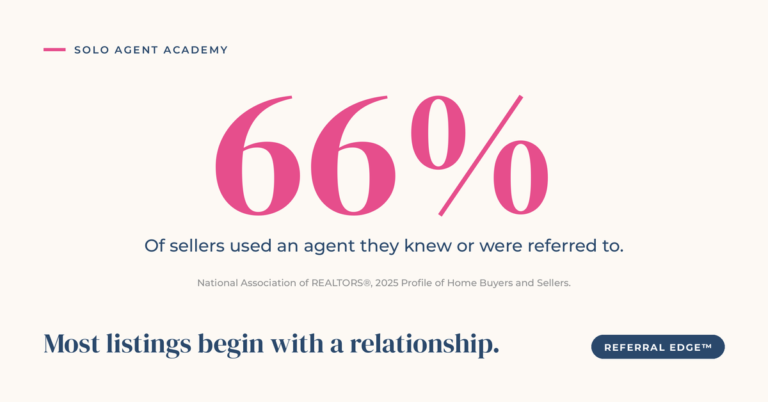
Ninety-one percent of sellers used an agent, matching the highest share NAR has ever recorded. For sale by owner fell to 5%, the lowest on record. Eighty-eight percent of buyers purchased through an agent or broker.
The consumer has not fired us. They have not decided the internet is enough. In a market this difficult they are using agents at record rates.
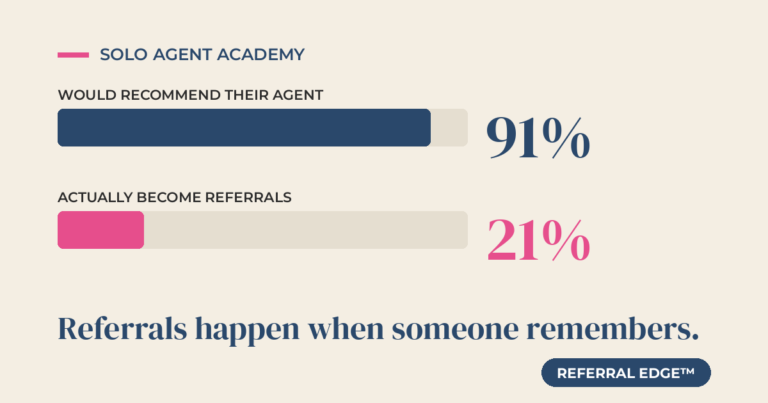
Now the two numbers that should change how you spend Monday morning. Forty-three percent of buyers used an agent referred to them by a friend, neighbor or relative. Another 18% used an agent they had worked with before.
They did not run a search. They did not compare a field of candidates. They asked somebody, or they went back to somebody.
A lead is not a stranger raising their hand
The industry treats a lead as an arrival. Something drops into the CRM, the clock starts, and the job becomes conversion — speed to lead, follow-up cadence, the whole apparatus.
Most of your business was decided before anyone filled in a form.
That is what the referral and repeat figures describe. By the time a person raises their hand, a shortlist already exists in their head, assembled over years from people they know and people they were told about. You are on it or you are not. A purchased lead does not put you on it. It buys you a conversation with someone whose shortlist was built without you, and then asks you to talk your way onto it inside ten minutes.
Sometimes that works. It is a poor foundation for a business.
This is not an argument against lead generation. It is an argument about sequence. Generating leads is what you do after you are the name that comes up, not instead of it.
Referrals are not luck, and they are not volume either
Referral business behaves like a mechanism rather than a mood, which is the whole premise of the 5 Referral Gears™. It turns or it does not, and when it stalls the cause is identifiable rather than mysterious.
There are five gears: past clients, current clients, business partners, agent-to-agent referrals, and your community and sphere. Five separate sources, each in its own state of repair. Most agents are running one or two of them well and calling the total their referral business.
The instinct, when it stalls, is to assume the list is too small. More names, more referrals. That instinct is the same arithmetic error as the one at the top of this article, applied to your own database instead of the country.
Because a list does not refer. People refer. And people only refer when they can remember what you do, believe you will handle their reputation carefully, and happen to be standing near someone who needs you.
None of those three things scale with the size of your database. Which I learned from two people at once.
Two databases, ten thousand contacts apart
Years ago I ran a coaching business in Alaska called Total Coach, working with loan officers and real estate agents on growing their businesses. Two clients from that period have stayed with me ever since.
The first had been in the industry more than forty years and had over ten thousand contacts in his database. After the mortgage meltdown, he was struggling badly.
The second had been licensed a little over two years and had fewer than five hundred contacts. He was getting referrals weekly.
I studied both, because on paper it made no sense at all.
What I found in the forty-year database was not neglect. He had served those people well and they had stayed. That was the problem. They were in their forever homes. A good number had second homes somewhere warmer. He had, without ever noticing it happen, worked himself out of a business — his contacts had aged past the stage of life where people transact.
He turned his attention back to first-time buyers. His business came back strongly.
Look at what had actually happened to him through the five gears. He had one gear turning — past clients — and he had run it beautifully for four decades. Then that single gear aged out from under him, and because it was the only one engaged, the whole engine stopped. The two-year agent had almost no past clients at all. What he had was community, and partners, and people currently in the middle of a move.
Neither of them bought a single lead. Both were top producers. One had twenty times the contacts of the other, and the size of the list was never once the variable.
What to do with the list you already have
Three things, none of which require a purchase.
Sort your contacts by life stage, not by the date you met them. Renting, first purchase, growing, settled, downsizing, done. Most databases are organized by when a name arrived, which tells you nothing about whether that person is anywhere near a transaction. Do a hundred names. The shape of your business will be visible before you finish.
Check where your last ten closings actually came from. Not where you think — pull the files. Referral, past client, or genuinely new? If the first two dominate and your marketing budget is aimed entirely at the third, you have found the leak, and it is not a lead-volume leak.
Pick the twenty people most likely to be asked “do you know a good agent?” and make sure they can answer specifically. Not that you sell real estate — what you actually do, and for whom. A referral needs a sentence someone can repeat. If the people closest to you cannot produce that sentence, nobody further out can either.
The arithmetic was never going to work
You cannot divide your way to a client.
Consumers do not distribute themselves evenly across licensees, which is why the size of the licensed population tells you nothing about the size of your opportunity. And the size of your database tells you just as little.
The forty-year veteran had ten thousand contacts and a demand problem. The two-year agent had under five hundred and a referral every week. The difference was not volume on either side of that comparison. It was whether the people on the list were anywhere near a decision, and whether they knew what he was for.
You do not need more people to know you exist. You need the right people to remember what you do when somebody near them asks.
One next step
Find out why someone would send you a name
The Referable Self-Assessment walks you through what makes an agent easy to refer, and shows you where your own referral mechanism is quietly stalling.
Take the assessment →