Why No One Responds to Your CRM Campaigns
You have hundreds of people in your CRM. Maybe thousands. The campaigns are running, the emails go out on schedule, the texts fire on day three and day ten, and almost nobody writes back.
So you add another campaign, or buy another lead source, and the silence continues.
The problem is not how often you reach out. It is what you send. Most CRM campaigns never say anything only a real estate agent could say, and people do not answer messages that could have come from anyone.
Why More Follow-Up Hasn’t Fixed It
Sales culture has spent decades hunting for the magic number of touches. Five. Eight. Twelve. The most repeated version claims 80% of sales happen between the fifth and twelfth contact, credited to a “National Sales Executive Association.” In 2014, VentureBeat went looking for that organization and could not find it. Sales & Marketing Executives International later said the figures most likely trace to a 1942 survey its Long Island chapter ran of its own members, with fewer than 40 responses.
That is the foundation under a lot of real estate follow-up advice: a number from a room of salespeople during World War II, describing a different industry entirely.
So the industry built campaigns around frequency. Most CRMs ship with prewritten ones, and add-on libraries sell hundreds more. They were written once, for every market at the same time. That is why they talk about spring in March, pool season and holiday décor, and why so many of them amount to the same three questions: Are you still looking? Have you talked to a lender? Just checking in?
Every one of those asks the contact for something. None of them gives the contact anything.
Which brings up a question most agents have never actually sat down with. What is your job? Not your title. Your job. What do people need from a licensed real estate professional that they cannot get anywhere else?
What Buyers and Sellers Say They Get From You
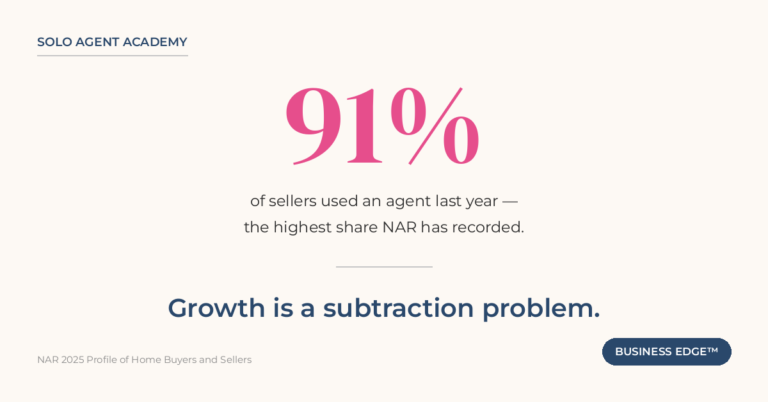
The National Association of REALTORS® asks recent buyers and sellers that question every year. In its 2025 Profile of Home Buyers and Sellers, 88% of buyers purchased through an agent or broker, and 91% of sellers sold with an agent.
What buyers credited their agent with is the useful part. More than half said their agent pointed out features or faults in a property they would have missed, and more than half said the agent helped them understand the process. Four in ten said the agent improved their knowledge of the areas they were searching.
That is knowledge. Not reminders.
And look at how sellers chose that agent. The two largest answers were people they already knew: 37% were referred by a friend, neighbor or relative, and 29% used an agent they had worked with before. On the buyer side, 43% found their agent through a friend, neighbor or relative.
Sellers hire someone they already know, and buyers value what that person knows
How sellers found their agent
Share of sellers, 2025
What buyers say their agent did
Share of buyers, more than one answer allowed
Sellers choose an agent they already know. Buyers value what that agent knows. Both point straight at your databank.
Source: National Association of REALTORS®, 2025 Profile of Home Buyers and Sellers, Exhibits 4-1, 4-5, 4-6, 7-1 and 7-2. U.S. buyers of a primary residence and sellers who completed a transaction between July 2024 and June 2025. 6,103 responses from 173,250 surveys mailed July 2025. All figures from one survey.
Put those findings next to the messages most CRMs send. Your next seller is most likely already in your databank, or knows someone who is. And when buyers describe what you did for them, they describe things you know and they do not. Your follow-up should be built from that.
Follow-Up Is a Service, Not a Reminder
The common approach treats follow-up as a count: more touches, more automation, set it and forget it. The industry is not wrong that consistency matters. It is wrong about what is being repeated.
Stop asking how many times to reach out. Ask what you are giving people a reason to answer.
Here is the standard I hold my own business to. Every contact in my databank has five campaigns assigned to them at the same time. Not five messages. Not five touches. Five separate systems, each one delivering something a local licensed professional knows.
Agents were told the internet would replace them. It did not, because information is not the same thing as interpretation. The same holds now. Before you connect an AI tool to write your campaigns for you, find out what client data it can read and what you agreed to when you clicked connect. Your databank holds private information that people trusted you with.
Where Campaigns Fit in the Business Flywheel™
The Business Flywheel™ runs in one direction: Actions, then Conversations, then Appointments, then Agreements, then Closings. Every closing starts as an action taken months, sometimes years, earlier.
A CRM campaign is an action. Your Quiet Team™ performs it for you around the clock, which is exactly why it is so easy to stop looking at. But an action only moves the flywheel when it produces a conversation. A campaign that sends forty messages and starts no conversations has not done its job, no matter how busy the activity report looks.
That is the measure. Not messages sent. Conversations started.
The Day I Printed Every Campaign
The stack of paper on my desk was a little shocking.
This was about four years ago, in Alaska. I was frustrated with how many people sat in my CRM and how few of them answered, so I printed every smart campaign I was running. Every email. Every text. Then I read them the way a client would.
I did not talk that way. The messages did not sound like me, and some of them did not even make sense where I lived. Spring does not arrive in Alaska in March and April. We still have snow on the ground. Nobody up there was thinking about outdoor pool season. And yet those messages were going out under my name.
So I went looking for CRM add-ons. A couple were recommended by the coach I was working with at the time, and I plugged them in. They were not local, and they still did not sound like me.
Finally I watched the training videos for the CRM I used then, Follow Up Boss, and taught myself to build my own campaigns. I was not great at it at first. And I made one mistake I do not want you to make: I forgot to put a final task at the end of every campaign. Contacts finished a campaign and quietly fell off the end of it.
I tracked everything in my Edge Business Partner™ planner: how many emails went out, how many texts, and what came back. And people started answering. Not everyone, not every time, but I was having conversations again, because the messages sounded like me and carried information only a licensed real estate agent would have.
How to Build Five Campaigns for Every Contact
Start with what a campaign can hold. Almost every real estate CRM gives you four actions: emails, texts, phone calls and tasks. Emails and texts send automatically. Calls and tasks do not, and that is the point. The CRM tells you when to show up. It should never pretend to be you.
No one can hand you the perfect five. Your market, your niche and your clients are not mine. But three campaigns belong on almost every contact, and most agents are not running any of them.
1. An MLS search. Every contact gets a relevant search from the MLS: homes that match what a buyer wants, activity around a homeowner’s neighborhood, or the area someone hopes to move to. Then the campaign creates a monthly task for you to check it. Is it still running? Is it still right? That task gives you a real reason to reach out: “I’ve been watching what I’m sending you. Are these still the homes you want to see?”
2. A weekly market update. This one goes to everyone, unpersonalized. “Just wanted to keep you informed on what’s happening in our market. If you know someone who could use this, pass it along.” Everyone knows someone who owns, wants to own or needs to sell.
3. A monthly market report. Mine is a link to the market video I record each month. I am doing them now for Northeast Alabama and Northwest Georgia. Once a month, everyone in my databank hears from the local agent who is actually watching the numbers.
MLS information, weekly interpretation and monthly analysis. Those are not drip messages. They are services, and only a local licensed professional can deliver them.
Then build two around the person. A niche campaign. Homeowner information. An annual home review. Seller preparation. Long-term buyer education. Holidays are fine too, if that fits your people. Just make it local and make it memorable.
Put a handwritten note in every campaign. Yes, every one. If you are thinking that most of your contacts are buyer leads and you do not know where they live, ask. One message in each of my campaigns confirms the address: “Is this still a good mailing address for you?” If none is on file: “Can I get your mailing address in case I need to send you something?” People give you information when they believe something useful is coming.
Build for ten years, not ninety days. My campaigns run ten years. People do not move on a lead-conversion timeline. A job changes, a baby arrives, a parent needs care, the house gets too big. When that happens four years from now, you want to be the agent who spent those years showing what you know, not the one asking whether they are ready yet.
End every campaign with one task: CAMPAIGN ENDED — ASSIGN NEW CAMPAIGN. It is the sentence I forgot, and it keeps anyone from falling off the end.
Thirty Days of Work, Ten Years of Follow-Up
Building this might take you 30 days. Good. Take them. Write the emails, the texts, the call tasks and the notes. Connect the weekly update and the monthly report. After that, I add the new market update each week and the new video each month, and my CRM does the rest. Thirty days of building buys roughly 3,650 days of follow-up.
Before you buy another lead, open your databank. Look at the first name. How many campaigns are working for that person, and would you answer what they are getting?
One next step
Rewrite the first message your CRM sends
Paste in your current new-lead message and get back a four-touch follow-up sequence written in your own words, for your market.
Rewrite my first campaign →