
Tools › Market Edge™ › The Decision Gap Loop Workbook™
The Decision Gap Loop Workbook™
Your pipeline already has stages. This is where you find out which ones everyone is standing in.
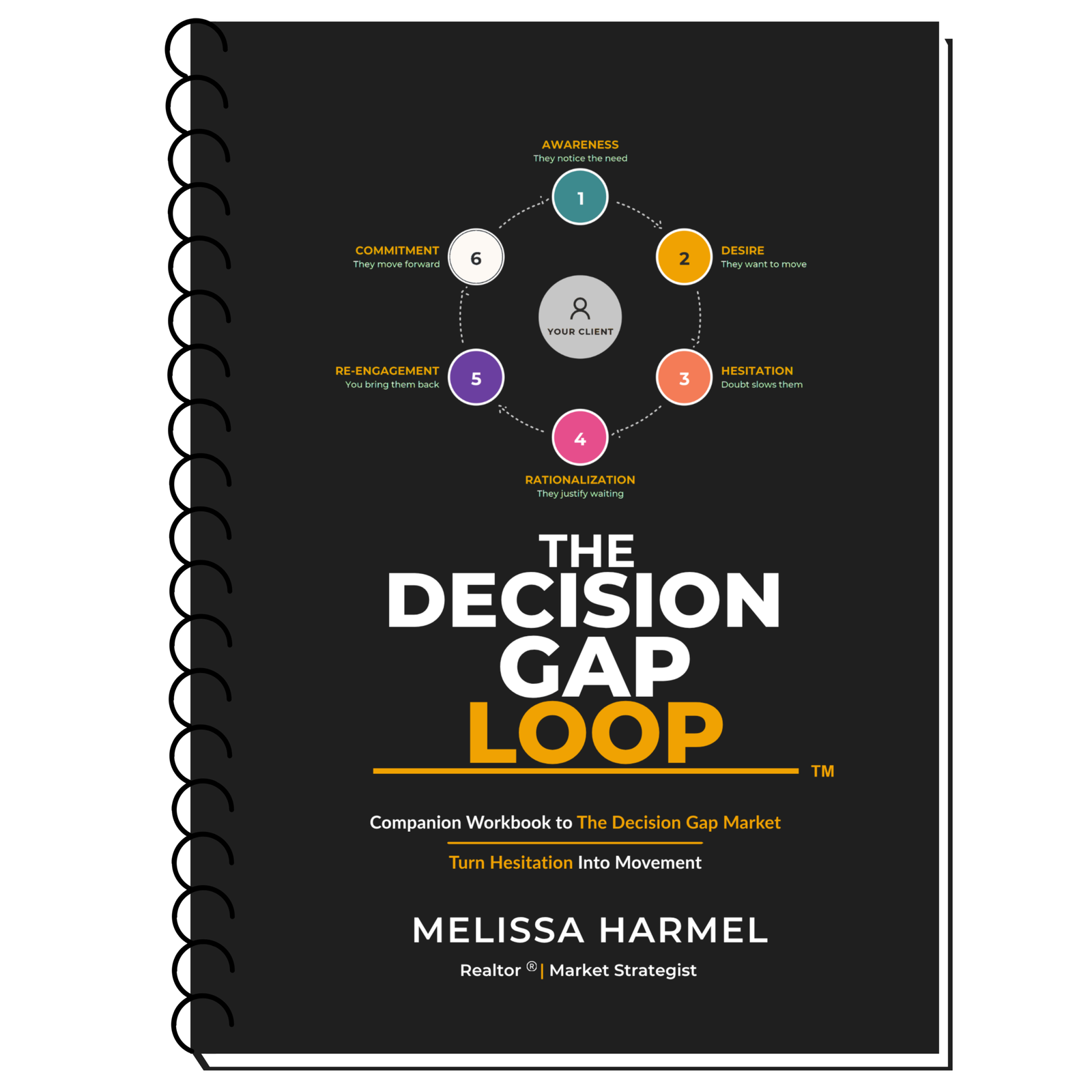
The companion workbook to The Decision Gap Market. Tag every contact in your CRM to a stage of the six-stage Decision Gap Loop™, have the conversation each stage actually needs, and run a 90-day plan that moves people toward a signed agreement.
- Format
- Spiral-bound, 8.5×11 · 296 pages
- Price
- $39.97
- Includes
- Online Loop Toolkit
Printed and shipped by Lulu. Spiral-bound so it lies flat next to your CRM.
Why this workbook exists
Your pipeline isn’t dead. It’s mid-stage.
Somewhere in your database is a couple who talked to you in March, went quiet in April, and will buy something this fall. Right now they look identical to the leads who were never going to move — same silence, same non-response, same slot in the CRM.
That’s the whole problem. Without a stage, every quiet contact looks like the same thing, so every quiet contact gets the same follow-up: a check-in that says nothing, sent whenever you remember. It’s the message most likely to be ignored by the person most likely to buy.
Reading the loop fixes that, but only if you actually sort your people into it. That’s work — a few hundred names, one stage at a time — and it doesn’t happen from reading a chapter about it.
The book teaches the loop. This is where you build it into the week.
Each stage gets its own chapter, its own list of your real contacts, and its own campaign — so the person in Rationalization gets the numbers and the person in Awareness gets something useful, not another “just checking in.”
The spine of the book
Six stages. Six chapters. Your actual contacts in each one.
Every stage runs on a different conversation and a different campaign. Each chapter shows you a completed example, has you do the same work on your own contacts, then gives you a checklist to correct it — and ends with 10 to 20 real people and the next move for each.
1
Awareness
Curiosity without commitment — and where most relationships quietly begin.
What you build
- Your Counted vs. Contacted number and a lead source chart
- The “what stalled?” message and five first messages, in your voice
- The five-month Awareness campaign for buyers, sellers, and investors
2
Desire
Emotion has entered. The math hasn’t yet, and rushing it shrinks the vision.
What you build
- A Desire Profile in their words — before any MLS search
- The search built from what they told you, after conversation five
- The 97-day Desire campaign
3
Hesitation
The longest stage in the loop, and the one where most deals quietly come apart.
What you build
- A Fear Map: which fear you’re hearing, in their words
- The four-move Hesitation conversation — normalize, name, separate, offer facts
- The 60-day Hesitation campaign
4
Rationalization
Delay dressed as logic — sometimes wise, often fear in a better suit.
What you build
- Your Local Numbers Sheet, known cold
- The Whole Picture: current home vs. next home, every monthly cost
- A personal market video for one contact’s slice of the market
5
Re-Engagement
The stage most agents skip entirely — and the one that’s earned months earlier.
What you build
- A Re-Engagement Review, one contact at a time
- Messages written for your market with the Campaign Prompt Builder
- A timeline worked backward from the date they name
6
Commitment
Hired — a signed buyer or listing agreement. Then you protect that decision all the way to the closing table.
What you build
- A hiring meeting built from their words, fear, numbers, and timeline
- A Commitment File for every signed client
- A checkpoint plan from signature to keys
How it’s structured
Three parts. Built to be worked, not read.
Part I · See It
See your market and set up your CRM
Prove the Decision Gap Market from your own MLS, see where the Loop lives inside the funnel you were trained on, and install the Loop in your CRM — stages, tags, and fields — with your first ten contacts tagged.
Part II · Work It
Work each stage
One chapter per stage. Learn it, find the 10 to 20 people already standing in it, and have better conversations with them — on the phone, by text, at open houses, and at the ball field.
Part III · Run It
Find the hole. Run the 90 days.
Put your whole CRM on one page, name the one hole to fix first, and run the 90-Day Loop Plan — ten percent of your contacts a week — until every contact has a stage you chose. Then do it again.
Roughly 30% reading, 70% work. If you finish a chapter with nothing written down, the chapter failed.
What comes with it
The workbook, the Toolkit, and fresh pages for every round.
In the workbook
40 Build It Yourself guides
Step-by-step guides for every piece you build from your own MLS and local data — market snapshots, inventory reports, your weekly market video, closing cost and tax references, your lender bench, and more.
Online, for workbook owners
The Loop Toolkit
43 client handouts you brand as your own in Canva, client links like The Whole Picture, and workbook-only agent tools. The access code is printed in the workbook.
For your next round
90-Day Loop Plan Refill Packet
Week 1 through Week 12, ready to print — one full round of the plan from Chapter 11. Instant PDF download, $7.
This is for you if
- You’ve read The Decision Gap Market and want it running in your business, not just understood
- You have a database with real people in it and no idea which ones are close
- Your follow-up is honest effort applied at random intervals
- Clients go quiet and you can’t tell processing from gone
- You’d rather guide a decision than push one
- You’re staying independent and need systems, not a bigger payroll
This isn’t
- A lead-generation program or a source of new strangers
- A set of closing techniques for overcoming objections
- A book you read once and shelve
- A substitute for reading The Decision Gap Market — the book teaches the loop, this is where you put it to work
- Software. It’s paper, on purpose, because paper gets used — with an online Toolkit for the pieces that belong on a screen.
Free tools
Start reading stages this week.
These six tools are free and live now. They won’t tag your CRM or run the 90-day plan — that’s what the workbook is for — but they’ll tell you where a specific client is standing today, and that’s enough to change the next conversation.
And start with the book. The Decision Gap Market lays out all six stages and the thinking behind them. The workbook is where you turn that into action — the lists, the cadence, and the conversations that change what your business actually does next week.
Start your first round.
The Decision Gap Loop Workbook™ is available now — 296 spiral-bound pages, the online Loop Toolkit, and a 90-day plan you can run on your own CRM starting Monday.