
The Framework
The 1-to-5 Listing Hub™
One listing at the center. Five returns radiating out — and they arrive on five different timelines.
A listing isn’t a transaction waiting to close. It’s a sign in the ground, a reason to talk to every neighbor, a magnet for buyers, and a public demonstration of how you work — all running at the same time.
Most agents collect one of the five and let the other four expire with the sign coming down. Not from carelessness — from not having a system running while they were busy closing the sale.
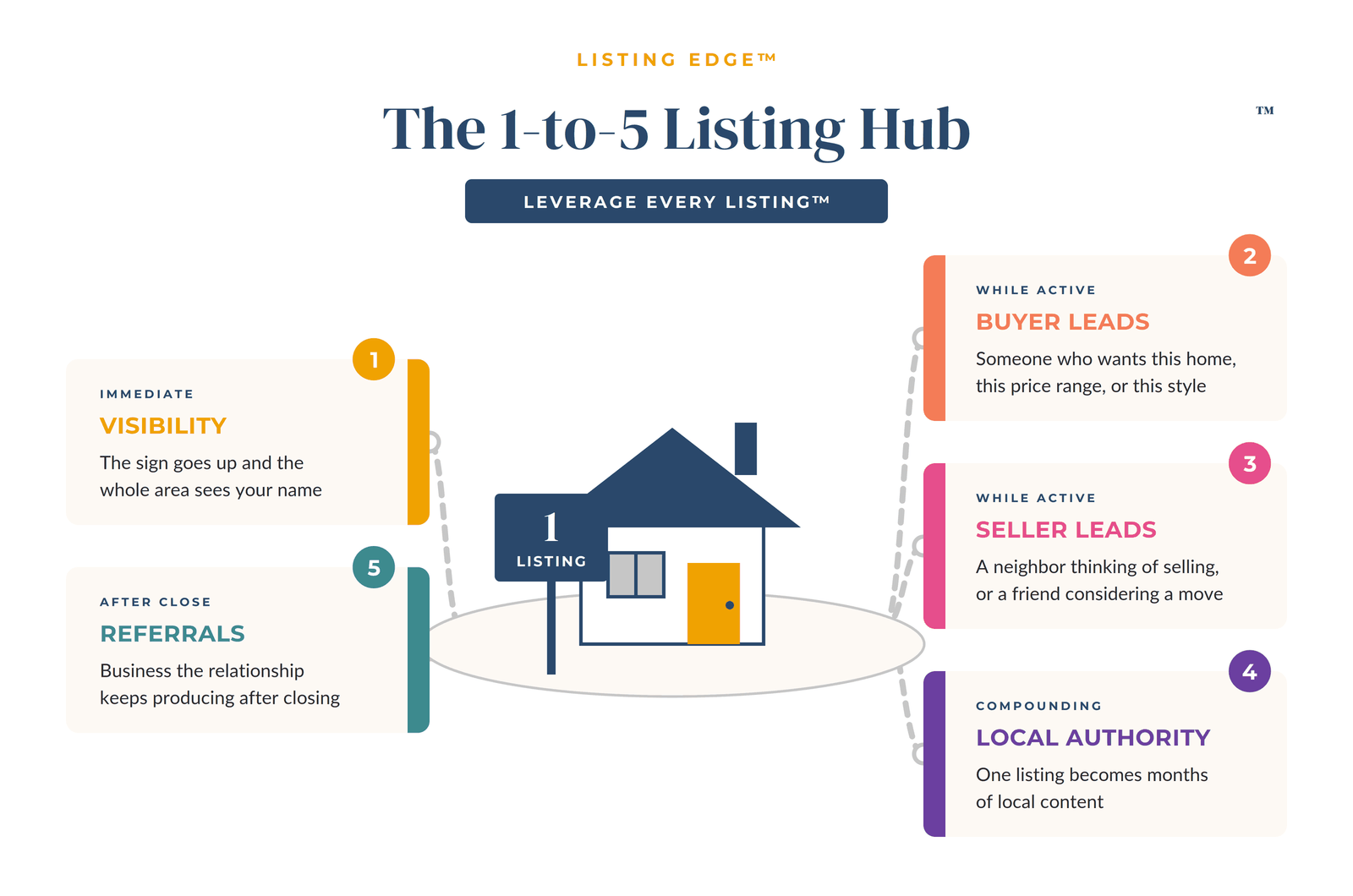
One listing in. Five returns out.
Most listings get used once
Here’s the pattern in most agents’ businesses: win the listing, market the property, close the sale, move on. The listing did one job — it closed — and everything else it could have produced quietly expired the day the sign came down.
The buyers who called about it and never got followed up with. The neighbors who watched the whole sale and never heard from you. The story that never became content. The seller who was thrilled at the closing table and was never asked to tell anyone.
None of that is a work-ethic problem. It’s what happens when the only system running is the one that gets the property closed — because that system has a deadline attached and the other four don’t.
One closing from a listing is the floor, not the ceiling.
The difference between agents who grind for every deal and agents with momentum isn’t listing count. It’s what happens around each listing while it’s in their hands.
You don’t own it. You work it.
A listing was never yours. You don’t own the property, and it leaves your business the day it closes. What’s yours is what you do with it while it’s in your hands — the attention it draws, the conversations it starts, the credibility it builds on one specific street.
“I got the listing.”
→
“I have inventory to work for ninety days.”
“It closed. On to the next one.”
→
“Which of the five did I actually collect?”
“That buyer wasn’t right for this house.”
→
“That buyer is right for a house.”
“I need more listings.”
→
“I need more out of the listings I get.”
“The neighbors already know I sold it.”
→
“They know a sign changed. They don’t know me.”
The five returns
Ordered by when they arrive.
They aren’t five names for “exposure.” Each one has its own timeline, its own way of being collected, and its own way of being lost.
1
Visibility
The moment it lists
The sign goes up and your market sees you working. This return is immediate, specific to this listing, and the only one that happens whether or not you do anything — which is exactly why agents assume it’s the whole story.
It’s also the shortest-lived. Visibility from a sign lasts as long as the sign does, and it says one thing: this agent has a listing. Everything else you’d want it to say has to be added on purpose.
How you collect it
Announce it properly across your channels, not just the MLS. The coming-soon, the listed post, the price improvement, the pending, the sold — five moments, not one.
How it’s lost: the sign does the work alone, and the only people who see it are the ones who drive that street.
2
Buyer Leads
While the listing is active
The calls, the showings, the open house conversations. People actively looking for a home in this range, in this neighborhood, right now — arriving pre-qualified by their own interest in a specific property.
Almost all of them won’t buy this house. That’s the point most agents miss: a buyer who toured your listing and passed is still a buyer, and they’ve just told you their price range, their area, and what they didn’t like.
How you collect it
Capture real conversations rather than sign-in sheets, and follow up on every one within days. An open house run well produces a pipeline; run badly it produces a stack of names.
How it’s lost: the showing ends, the name goes in a folder, and nobody calls. This is the most commonly abandoned return of the five.
3
Seller Leads
While the listing is active
Neighbors watching how you work. Owners nearby who were already half-thinking about it and just watched a house on their street go under contract. The seller’s own circle, who are hearing about the experience in real time.
This return is the one with the best odds and the least attention, because the audience is small, local, and already paying attention. They are watching whether you want them to or not — the only question is whether they ever hear from you.
How you collect it
A neighbor outreach rhythm that runs on schedule, not on remembering. Just listed, just sold, and what it means for their own street — with a real number attached.
How it’s lost: silently. They list with someone else next spring and you never know the sale on their block was the reason they started thinking about it.
4
Local Authority
Cumulative, across listings
This one is different in kind. Visibility is an event — one listing, one moment. Local authority is a reputation, and it’s built from the whole portfolio rather than any single property.
Every listing hands you something real to say about a specific market: what it listed at, what it sold for, how long it took, what buyers responded to. That’s not marketing material, it’s evidence — and almost nobody in your market is translating the national news into what actually happened on one street.
How you collect it
Turn each listing into content about the market rather than the house. One listing in your niche supplies weeks of it, and the value compounds across every listing you’ve ever had.
How it’s lost: this is the return most agents leave entirely on the table. Nothing visible happens — you just stay an agent with listings instead of the person who explains the market.
5
Referrals
After the close
The relationship keeps producing long after the transaction is filed away. A seller who had a genuinely good experience is the most credible marketing you will ever have, and they’re at their most enthusiastic in the weeks right after closing.
Which is also, for most agents, the exact moment contact stops. The file closes, the commission arrives, and the person who would have recommended you to three people never gets asked or reminded.
How you collect it
A post-close flow that starts within days and runs for years. The experience is the foundation; the follow-up is what turns it into referrals rather than a fond memory.
How it’s lost: slowly, to silence. Three years later they list with whoever’s sign they drove past last week.
Why this changes the shape of a year
The arithmetic here is the whole argument. Take an agent with six listings a year who collects one return from each — six closings, and a business that starts every January from zero:
Listings × returns collected = what the year actually produces
| Six listings | What the year produces |
|---|---|
| 1 return | Six closings, and a pipeline that empties every time one closes |
| 3 returns | Six closings plus buyers, plus the neighbors who start calling |
| 5 returns | All of that, plus a local reputation and referrals still arriving in year three |
Illustrative — the point isn’t a multiplier, it’s that four of the five returns cost you almost nothing extra and most agents collect none of them.
You don’t need more listings. You need more out of the listings you already win.
Five listings a year, worked through the whole hub, produce a fundamentally different business than fifteen listings worked once each — and they’re a great deal easier to get.
What collects the returns
Four of the five have no deadline.
The closing has a contract date, which is why it always gets done. Neighbor outreach, buyer follow-up, market content, and the post-close flow have nothing forcing them — so in a busy quarter they’re the first four things to disappear.
Your Quiet Team™ runs the flows
Neighbor campaigns triggered by listing status, buyer follow-up sequences, and a post-close flow that starts on its own. The four returns with no deadline get one.
Your planner tracks the listing
The Edge Business Partner™ holds the listing work alongside everything else and counts it, so you can see by Friday which returns you’re actually collecting.
You do the listing itself
The appointment, the pricing conversation, the seller experience. The part that wins the inventory and makes the other four returns worth collecting.
Start free
The Listing-Generated Business Planner
Take one listing — active, pending, or closed last month — and plan all five returns from it. No signup, no email required.
Work your next listingIn development · October 2026
The Listing Momentum Book
The full argument behind the hub: why a listing is inventory rather than a transaction, what each of the five returns is actually worth, and how agents with fewer listings build more momentum than agents with more.
Written for the solo agent who wants the next listing to do the work of three.
Kindle, audiobook, paperback, and hardcover · October 2026
Free tools for working the hub
Work the whole hub.
Your next listing is more than a closing. It’s five returns waiting to be collected, four of which cost almost nothing extra and none of which collect themselves. Win it, market it, and take everything it gives you.