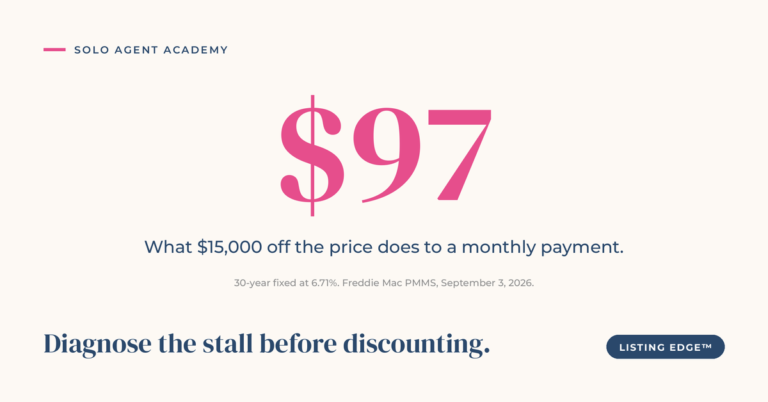
Somewhere around day 30, a listing picks up a label: stale. The market has seen it. Every buyer who was going to want it has already looked and passed, and every week from here is another week with nothing new to tell the seller.
The usual fix is a price reduction, because what else changes a stale listing?
That belief earned its place. For most of the last five years, a house in the right location, in good condition and priced where buyers saw the value drew its buyers in the first seven to ten days. They were already lined up, preapproved and waiting, so the first week really was the market’s verdict. If it didn’t sell then, something was wrong, and price was the fastest lever to pull.
But that only holds when the buyer pool is fixed, and in a market where buyers have time to hesitate, it isn’t. Buyers enter the market every day. I watched it happen in real estate, then from the marketing side of the mortgage industry, then back in real estate again.
In any given week someone gets preapproved for the first time, someone accepts a transfer, someone’s lease runs out in ninety days, someone’s deal on another house falls apart. And some of the buyers sitting in an agent’s queue the week your listing went live weren’t ready yet. They were still hesitating. They’re ready now.
To every one of them, your listing isn’t stale. It’s new. The house you listed 45 days ago is a brand-new listing to the buyer who started searching yesterday.
So the question changes. Not “how do I revive a dead listing?” but “how do I put this listing in front of the people arriving this week?” That is work, not a price cut.
It starts in the MLS, because the MLS is where the market talks back. Go back to your list date and pull everything that has come on since, everything that went pending, sold, reduced, expired or withdrew. Then ask the only question that matters: what did buyers choose instead of yours?
Open those listings and study the condition, the location, the photos, the concessions, the price. I’ll be honest, I’m now working two MLS systems in Georgia and Northeast Alabama that look nothing like the ones I used in Tucson and Anchorage, and I have struggled with them. The research is still the job.
Then refresh what the new buyer actually sees. Every change you make in the MLS feeds out to Zillow, Realtor.com and the other portals, and I refreshed my listings constantly because, in my experience, a fresh listing gets a second look. Swap the lead photo. Reorder the gallery. Rewrite the first two lines of the remarks around what your showing feedback says buyers notice.
And don’t load every photo on day one. Leave a little room for the imagination, and hold a few back so you have something genuinely new to add later. I’d touch something every five days and audit the whole presentation every 14. None of it costs money.
And work the listing, not just the portals. The 1-to-5 Listing Hub™ treats every listing as five returns: visibility, buyer leads, seller leads, local authority and referrals. If you put the house in the MLS, let it syndicate, made one social post and called that marketing, you’ve worked one of five. Run a Mega Open House. Go back to the neighbors. Call every agent who showed it, and the agents whose buyers just lost out on something comparable.
None of this means price never moves. Sometimes buyers keep choosing comparable homes over yours, and the data gets hard to ignore. But days on market alone diagnoses nothing. Condition, competition, presentation, access, concessions and price all matter, and your seller deserves a diagnosis before a prescription.
Think about a store shelf. Not everything on it arrived yesterday. Some of it has been there for months, and one afternoon the right customer walks in and buys it. The store didn’t change the price. The customer just arrived.
A house is a far bigger decision than a cup of coffee at Starbucks, with financing, a down payment, a lease, a school year and a commute all in play, which is exactly why buyers arrive on their own schedule and not yours.
One next step
The Stale Listing Reset
A 14-day workbook that walks you through the MLS audit, the diagnosis, the refresh and the seller conversation, so the next buyer meets your listing at its best.
Get the Reset →